A newborn, a husband at the front, and volunteer work: being a woman in Ukraine today
By Svitlana Dukhovych
Olena Mosendz is a young woman, born and raised in Nova Kakhovka in the Kherson region in southern Ukraine. Her city is now under Russian occupation. At the start of the full-scale war, the young woman left her job as a lecturer at the Catholic University of Lviv and moved to Zaporizhzhia: on the one hand to be closer to her family, who shortly afterwards managed to flee the occupied city; and on the other, to send medicines, first to the occupied part of the Kherson region and then to military doctors on the front line.
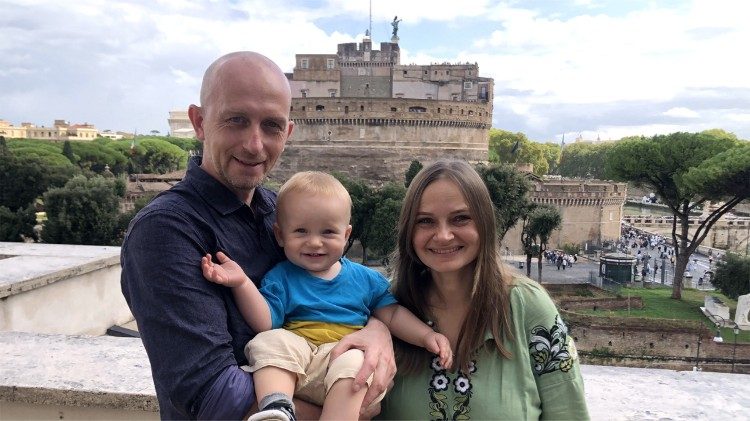
At the end of 2023, Olena married a soldier serving in a medical unit and now, in addition to volunteering, she also works as communications manager at Caritas Ukraine. At the beginning of October, she came to Rome for a short vacation with her husband, who had been granted leave, and their one-year-old son, Luca.
In an interview with Vatican News, Olena spoke about the difficulties she faces as the mother of a small child and wife of a soldier in such difficult times, and how she manages to balance all this with volunteering and work.

War, conscience, and priorities
"Education is of fundamental importance to me: I care deeply about the values of university and the training of future journalists and communicators. However, when our country is fighting for survival, priorities change," said Olena, recalling how in 2022 she decided to leave Lviv - which is a relatively safe city - give up her teaching job at the faculty of social communications, and move to Zaporizhzhia, near the front line.
"My conscience told me that I had to go and help save lives. I am happy that so many continue to teach, but I understood that, thanks to my contacts, my network of acquaintances and friends – especially among Catholics around the world – I could be much more useful.”
“Another thought that guided me was that at the time, not having children and not being married, I felt that my life was not so valuable that I feared losing it. We went to doctors who, risking their own lives, saved dozens, hundreds, and sometimes thousands of people, and I myself, even risking my life, could help hundreds of other people. And for me, the priority was clear."
Although this awareness of the risk to one's own life may seem very harsh, in the current situation in Ukraine “it is essential to assess the dangers with the utmost objectivity and critical thinking, preparing oneself to face them,” Olena said.
Mutual support
When she got married and found out she was expecting a child, she could no longer physically go to the areas where the fighting is most intense. “My responsibility was no longer just for my own life, but also for that of my child,” she explained. “But we reorganized our work so that I could continue to supply medicines: we buy them and send them to the front by courier.”
The woman recalls an episode when her son Luca was only two weeks old: "My husband had returned to military service. I was home alone with the baby and had to buy and send some medicine. So I put on a baby sling for the first time, put the baby in it, and went with him to the pharmacy to buy medicine for the doctors at the front.”
“Because this means saving lives, because thanks to this help, someone's husband, brother, or son will be able to receive timely assistance and survive. I also hope someone else will take care of my husband and my brother, who are also at the front. In fact, this is how we try to support each other in order to survive and leave a safe country for future generations”.
Love beyond distance
The love story between Olena and her husband began in the midst of the war, which puts a strain on many families and couples. There is no manual that explains whether a wife should visit her husband wherever he is, or whether he should visit more often, let alone how to keep a relationship alive when distance seems to divide them.
“When we got married,” said Olena, "I tried to visit him whenever I could, when I knew he was in a safe place, or at least relatively safe. But when I got pregnant, my trips inevitably became less frequent. That period was very hard: in the whole year, my husband only managed to come home twice, and for very short periods. When I gave birth, he came to see us in the hospital and stayed with us for the first ten days after Luca's birth, but then the distance separated us again for almost six months. It was the most difficult period, both physically and emotionally”.
“Yet the thing that weighed most heavily on me,” she continued “was not being able to share those first moments with him: holding the baby in my arms, witnessing his first smiles, experiencing his first emotions... all feelings that are almost impossible to put into words”.
“I eagerly waited for Luca to turn at least six months old, for the arrival of summer, so that I could finally get closer to him, even if only for a brief moment. This summer, when my husband's unit had a break in relatively safe locations, we were finally able to meet him. The greatest joy for me was seeing Luca’s father watch him take his first steps and discover his new skills.”
The father who can’t be seen
The most difficult moment for Olena is when she returns home after visiting her husband with Luca. The child, hearing a male voice on the street, looks for his father among the faces of the men he passes and becomes sad when he does not find him. This hurts her deeply, which is why she tries to do everything possible to ensure that her son spends more time with his father, even though she knows that this does not always depend on them.
Many families experience similar situations, and support communities for women, mothers, and sisters of military personnel offer help, advice, and support. Olena also tries, along with other women in the same circumstances, to support each other by sharing their experiences.
Being a mother to a newborn during wartime means living in extremely complex circumstances, where love, care, and joy are intertwined with fear, uncertainty, and constant worry. First and foremost, safety is the priority. Olena is used to planning many things in advance, but with a small child, every day brings new challenges.
“I never know what the next day will bring,” she said, "and everything becomes even more difficult when you live in a country at war. I have to constantly monitor the situation and think about what to do if there is no electricity, gas, or heating, or if I have to take my son somewhere else.”
“These thoughts are constantly running through my mind, and I always try to organize everything to ensure at least a minimum of comfort and safety for him. It's a very demanding task because no one has ever explained the ‘rules of the game’ to us. I never imagined I would have an experience like this, so we have to learn new things every day."
The Pope’s greeting
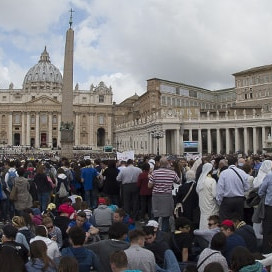
Returning to Ukraine, the Mosendz family brought home not only memories of attending the general audience at the Vatican, during which Pope Leo blessed little Luca, but also the solidarity of pilgrims from different countries around the world.
“When they asked us where we were from and we replied Ukraine, they told us they supported us and prayed for us. And I am taking this home with me to Ukraine, both for our soldiers and for my family. Because it is important for them to know that they are not alone, that someone remembers them. And I will gladly continue to spread this message,” concludes Olena.
Thank you for reading our article. You can keep up-to-date by subscribing to our daily newsletter. Just click here.