
Religious sisters stand with flood-affected coastal communities in Indonesia
By Mathias Hariyadi - Indonesia, LiCAS News
Every time the tide rises, the people of Sidodadi, a small coastal village in Pesawaran Regency in Indonesia, brace for another flood.
Waves crash against the shore, spilling into homes and washing away fishing nets left to dry in the sun. The sea that once sustained life has become a daily threat, forcing families to lift their belongings onto wooden stilts and pray that the next tide will be gentle.
In this small coastal village in Lampung Province, the struggle against rising seas has become part of ordinary life.
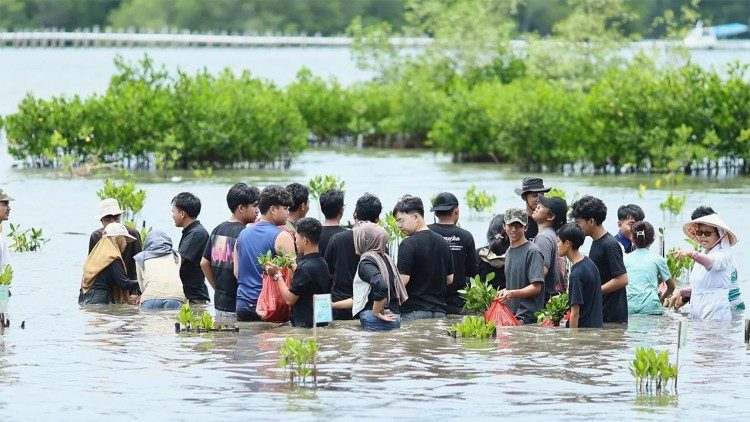
But along its muddy shoreline, a new kind of hope is taking root as villagers, students, and faith communities work side by side to plant thousands of mangrove trees and reclaim what the water has taken.
Among those leading the effort is Sr. Vincentia Sabarina HK, a nun of the Sisters of the Sacred Heart (HK) and the Education Animator of the Laudato Si’ Movement Indonesia.
Seeing how tidal floods were destroying homes and livelihoods, she helped turn local despair into a campaign for ecological renewal.
“Their homes can be flooded two or three times a day,” she observed.
From concern to collective action
Sidodadi’s fishing families have long faced erosion and shrinking catches. “These days, even getting two to four crabs and some fish has become difficult,” Sr. Vincentia said.
Moved by what she witnessed, she joined hands with Pak Aan, a local fisherman who began cultivating mangrove seedlings. Together, they launched a community-based replanting effort to protect homes and restore the shoreline.
The Laudato Si' animator said the initiative grew from faith and urgency.
“Once, this area thrived on abundant marine harvests. Now the muddy mangrove flats tell a different story,” she noted.
Faith meets ecology
Momentum came when the Diocese of Tanjungkarang adopted the pastoral theme “Love for Life and the Environment.”
Seizing the opportunity, Sr. Vincentia introduced a program titled “Cross-Sector Mangrove Planting toward Integral Ecology” in partnership with the Lampung chapter of the Laudato Si’ Movement.
Her call quickly spread online. “We managed to collect 1,000 mangrove seedlings,” she said. Dozens of students, including Muslim youth, donated and joined the effort.
The first planting phase took place on October 25, 2025. Two more are planned for March and July 2026, aiming for a total of 5,000 trees.
Interest exceeded expectations
Around 150 volunteers registered, but only 75 were accepted due to limited space.
“The decision wasn’t about exclusivity but practicality,” Sr. Vincentia explained. “Those who only want to take pictures don’t need to come. The 75 participants are those who’ve committed to jump into the sea and plant the mangroves along the shoreline.”
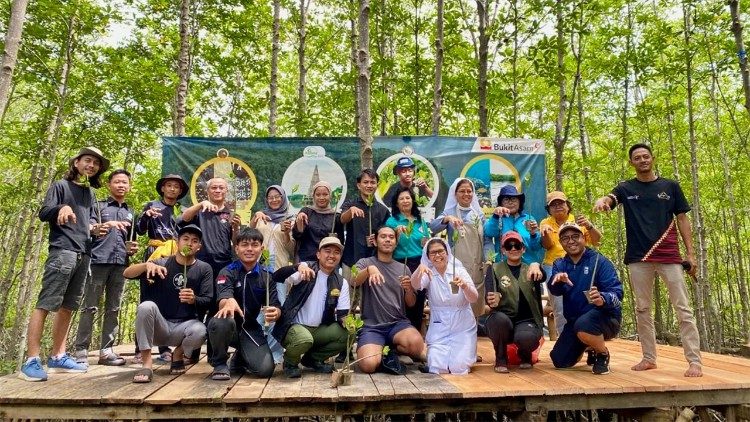
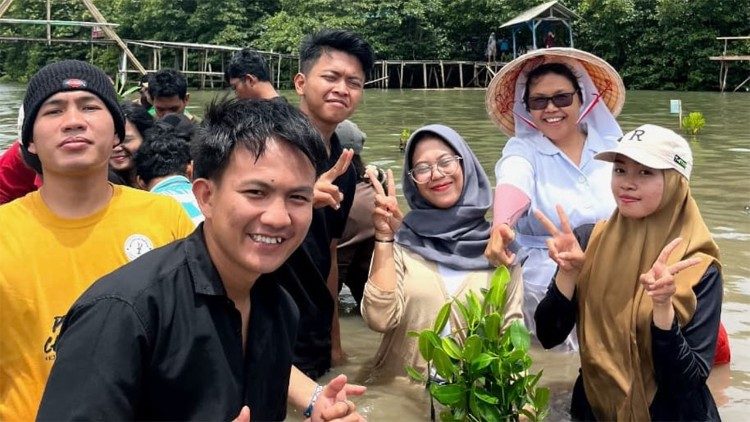
On planting day, the group trudged 300 meters into the tidal flats to embed seedlings in the mud. Sr. Vincentia was joined by fellow HK sisters Meriam, Sofie, and Yolanda.
The project, Sr. Vincentia said, goes beyond conservation. It is an act of solidarity linking fishers, students, and faith communities in the struggle for survival.
“Mangrove planting strengthens the coastline, restores the ecosystem, and safeguards livelihoods,” she said. “It’s not about how many trees are planted. It’s about how deeply we love the Earth we stand on.”

Facing the tides: limitations and challenges
Sustaining the mangrove program, Sr. Vincentia admitted, has not been easy. “Tides and seawater conditions determine everything, from planting to follow-up care,” she said.
The community adopted the gulutan method, placing about twenty seedlings in bamboo baskets weighted with mud so they are not washed away. “With this method, at least eighteen can survive and grow,” she explained.
Funding remains another hurdle. She said it is “not easy to find social funding for this mission of goodness,” adding that seedlings are available locally, “but what is difficult is finding money to buy them.”
The villagers themselves have undergone a drastic change in livelihood. Many who once lived entirely from fishing now raise mangrove seedlings instead. Yet most still go to sea, often returning with only a few crabs or small fish.
The ecological transformation, she said, “forces them to find other sources of income,” while learning to care for the coast that once sustained them.
Timing also matters. “We must follow the rhythm of nature,” Sr. Vincentia said. “If we plant at the wrong tide, everything could be lost.”
The nun stressed that education is another key challenge, adding that it is “vital to teach local residents that mangroves are the key to their future livelihoods.”
The Laudato Si’ team conducts regular sessions with villagers on why mangroves reduce abrasion, break waves, and nurture fish, shrimp, and crab habitats.
They also monitor the planted areas with the local management group, POKDARWIS, to ensure seedlings survive and dead ones are replaced.
Community and cooperation
To sustain the work, local residents have sought help from the regional authorities of Pesawaran Regency to address daily seawater flooding and coastal abrasion, including the construction of embankments.
The project also partners with universities, Muslim student groups, and other environmental organizations to widen participation and funding support.
“We want this to continue with more people involved, interfaith youth, cross-sector groups, anyone who cares for creation,” Sr. Vincentia said.
Signs of hope and continuity
Mangroves take decades to mature, but Sr. Vincentia said the community is already seeing change. The former fishing area is now managed as a Mangrove Ecotourism Zone, offering alternative income and environmental awareness.
“The benefits are beginning to be felt,” she said. “Maybe this small movement will become a new source of hope.”
The Lampung branch of the Laudato Si’ Movement continues to document the project as a living example of Pope Francis’ call in Laudato si’.
“It’s not merely a project or activity,” Sr. Vincentia said. “It’s a faith-driven initiative for the care of our common home.”
Thank you for reading our article. You can keep up-to-date by subscribing to our daily newsletter. Just click here.