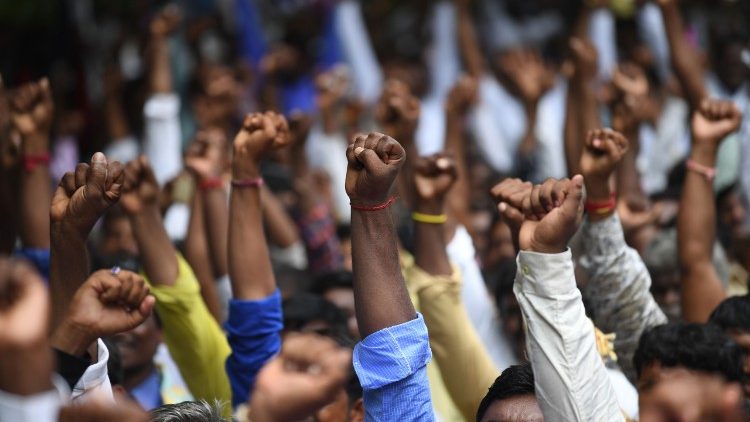
Bangladesh: Church walks alongside Dalits on path to dignity
By Sr. Christine Masivo, CPS
Millions of Dalits—the so-called “untouchables”, whose marginalization within Bangladeshi society has persisted long after the caste hierarchies that produced it were officially outlawed—live in Bangladesh. In the country’s southwest, the Diocese of Khulna has built its pastoral identity around one of the nation’s most overlooked social realities. For the local Church, ministering to this community is not a side project; it is close to the heart of its mission.
A Community Shaped by Exclusion
Although Bangladesh has a majority-Muslim population, accounting for 89 percent of its people, its national fabric still bears the legacy of the Hindu caste system, from which the practice of “untouchability” originated. The Vatican’s Fides news agency estimates that between three and five million Dalits live in the country today, many still confined to occupations long considered “impure”, such as street sweeping, sewer maintenance, waste collection and other forms of low-paid manual labour.
The country’s Constitution formally bans discrimination, but the lived reality tells a different story: limited access to schooling, difficulty entering the broader labour market and substandard housing remain common features of Dalit life. The Khulna region itself, a significant urban and industrial centre, is home to an estimated 500,000 Dalits, many of whom live in peripheral slums and informal settlements shaped by decades of economic and geographical marginalization.
Education, Employment and Everyday Support
Bishop James Romen Boiragi of Khulna describes a ministry built on practical accompaniment as much as on spiritual care. The diocese, established in 1952 and now part of the Ecclesiastical Province of Dhaka, spans eight districts and carries out its outreach through parishes, Catholic schools and Caritas programmes.
The Bishop explained that the diocese’s work centres on human development and helping families educate their children, while also assisting them in finding employment and meeting their daily needs—efforts in which Caritas plays a central role. Of the roughly 37,000 Catholics in the diocese, the majority come from Dalit communities, making this outreach central rather than peripheral to the diocese’s identity. Yet Bishop Boiragi is careful to note that social support, however vital, is not the whole picture: catechesis and educational formation remain at the core of the Church’s commitment.
He also observed that caste-based discrimination is not confined to one religious group. According to the Bishop, Dalits from the Hindu community are still affected by the problem, while caste-based discrimination also persists among both Muslims and Hindus in the wider society.
Faith as a Path to Dignity
For many Dalits, embracing Christianity has become intertwined with a broader search for social respect and personal renewal. Bishop Boiragi noted that conversion often changes how Dalits are treated, replacing customary discrimination with greater respect and, in practical terms, opening doors to better living conditions. The diocese works to ensure that this shift translates into genuine inclusion, drawing on constructive relationships with other religious communities and encouraging the wider Catholic community to receive new members as brothers and sisters.
Framing this in spiritual terms, the Bishop described the encounter with the Gospel as a rediscovery of dignity: the recognition of oneself as a child of God and liberation from oppression and marginalization. He added that this encounter is also concrete, since it frequently opens access to education and opportunities for personal growth.
In Khulna, evangelization and human development are treated as two expressions of a single mission. For a diocese whose Catholic population is largely composed of Dalits, that mission carries a clear conviction: proclaiming the Gospel can restore hope to the most vulnerable and help build a more just and inclusive society.
Thank you for reading our article. You can keep up-to-date by subscribing to our daily newsletter. Just click here.