Gaza's parish priest: 'Pope Leo encourages us to have hope'
By Francesca Sabatinelli
Pope Leo XIV expressed his hope for genuine peace in a message sent two days ago, on 4 May, to the Holy Family Catholic Church in the Gaza Strip.
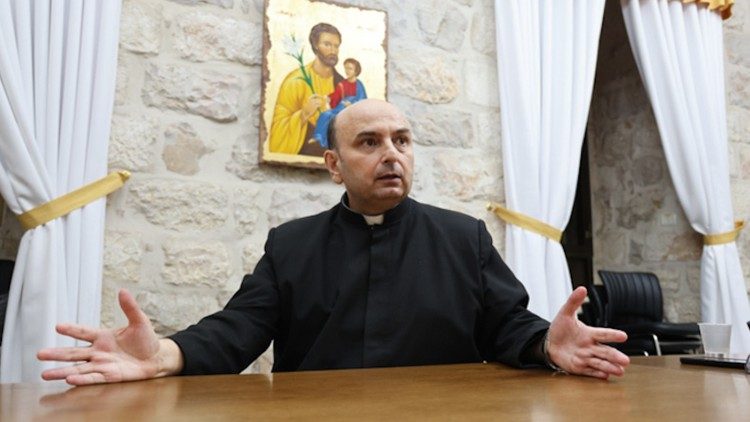
The Holy Father's message was made known by Father Gabriel Romanelli, the pastor of the parish in Gaza, in a video he posted on Instagram.
“The Pope,” Fr. Romanelli stated in the video, “sent us a message expressing his closeness, his prayers, his concern for the entire situation, praying day after day for the end of the war in Gaza, for the parish, for all the local people, so that the Lord may grant what the prayers of the Successor of Saint Peter, today Leo XIV, implores for the world: peace for Palestine, peace for Israel, conversion, and grace for all.”
The Pope’s Message
Father Romanelli further explained to Vatican media that “last Monday, the Pope sent us a written message,” a text in which Pope Leo XIV expresses “his closeness” to the Palestinian people, also in light of all the difficulties in delivering humanitarian aid, which cause “suffering for the people here in the parish and for many others.”
The Pope, the priest continued, “always gives us his blessing and always encourages us to have hope. The situation remains very delicate throughout the Gaza Strip, and so the words of the Holy Father, his prayer, and with him the prayer of the entire Church and of many people worldwide who desire peace, always encourage us to continue moving forward and doing good.”
Prayer for Peace
Describing the situation in Gaza, Fr. Romanelli noted that “the ceasefire that began in October has somewhat improved the situation, in the sense that there are no blanket bombings; however, people are still dying, being killed,” and so far, “more than 800” have died.
In addition, he emphasized that there is still a severe lack of humanitarian aid, water, electricity, basic necessities for life, and the hope that this situation may improve.”
In such a grave context, Father Romanelli concluded, “we always thank the Holy Father for his closeness and all the people worldwide who pray for peace—for Palestine, for Israel, and above all for the end of the war in this part of Palestine, Gaza.”
OCHA Alarm
According to the 1 May report from OCHA, the United Nations Office for the Coordination of Humanitarian Affairs, in the first four months of 2026, “just over 10% of the funding necessary to ensure critical humanitarian operations this year” has been secured.
Moreover, the report states, “restrictions on the entry of generators, motor oil, and spare parts are causing widespread system failures, reducing health and sanitation services, debris removal, and the mobility of humanitarian teams.”
Most of the population of the Gaza Strip, it reports, remains displaced, living in precarious housing, and exposed to increasing public health risks related to parasites and rodents, as well as ongoing strikes, bombings, and shootings.
Persistent difficulties
People, it found, “remain largely confined to less than half of Gaza, unable to access other parts of the Occupied Palestinian Territories, particularly the West Bank, or travel abroad, except for the small number of patients approved for medical evacuation and their companions.”
The alarm is extremely high, as OCHA warns of the rapid collapse of essential services due to “continued delays in the entry of lubricating oil and spare parts for generators.”
Possible irreversible failures of “hundreds of generators, water wells, desalination plants, pumping stations, and tanker fleets” could halt the production and transport of drinking water, which would increase “the risk of public health emergencies and epidemic outbreaks.”
Thank you for reading our article. You can keep up-to-date by subscribing to our daily newsletter. Just click here.