Pope Leo pays tribute to Jérôme Lejeune, defender of human dignity
Vatican News
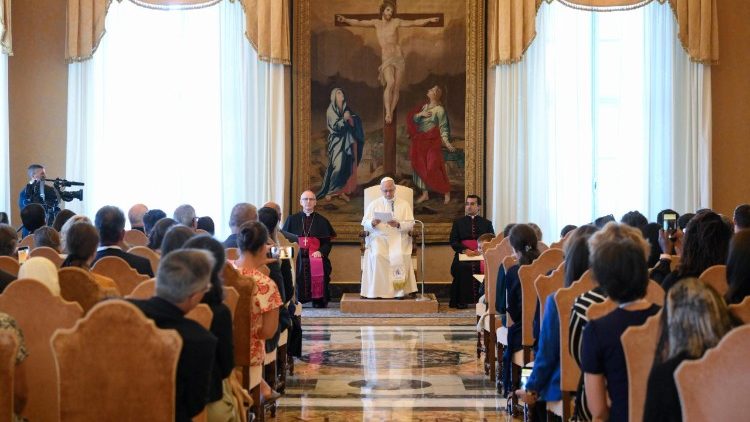
On the centenary of the birth of Venerable Professor Jérôme Lejeune, Pope Leo XIV received members of the Foundation that bears his name and continues his work.
In his address, the Pope recalled Lejeune as a pioneer of modern genetics, a physician devoted to the most vulnerable, and a tireless defender of life.
He urged members of the foundation to imitate his example and be “committed witnesses in society, at the service of the constant pursuit of the common good.”
Professor Jérôme Lejeune, who discovered the chromosomal abnormality responsible for trisomy 21, left a lasting mark on the history of modern medicine.
Regarded as one of the fathers of contemporary genetics, he dedicated his life to research and to the care of people with intellectual disabilities.
“Medicine,” he liked to say, “is hatred of disease and love for the sick person,” Pope Leo XIV recalled. That conviction, the Pope said, guided Lejeune’s service to those he affectionately called “the poor among the poor.”
A figure recognized by the Church
Pope Leo noted that, in recognition of Professor Lejeune’s academic excellence and tireless service to the Church, Pope St. Paul VI appointed him a member of the Pontifical Academy of Sciences.
He said Prof. Lejeune’s deep friendship with St. John Paul II and their shared commitment to the defense of life, which helped lead to the creation of the Pontifical Academy for Life.
Professor Lejeune, he said, saw the Academy as “a necessary institution in the face of the multiplication of threats against life.”
As a “man of science and wisdom,” Pope Leo continued, Jérôme Lejeune soon realized that his scientific discovery “would be used to eradicate people with trisomy 21 before their birth.”
For that reason, the Pope said, he did not hesitate to become “their advocate,” denouncing “the violation of the Hippocratic oath and this new eugenics,” which he called “chromosomal racism.”
Prof. Lejeune’s prophetic words led him to defend the life of every human person, founded on the inviolable dignity that has its origin in God’s creative act, the Pope said.
This commitment led him to challenge and advise institutions and leaders around the world, while also causing him to be mistreated in some scientific circles.
Technology cannot replace ethics
Pope Leo stressed that Prof. Lejeune understood that, while technology can assist medicine, it can never replace it.
Prof. Lejeune knew, the Pope said, that technology can also be used against medicine, which by its nature is at the service of life.
The value of a person, he continued, never depends on performance, autonomy, or social usefulness.
“Never should a doctor allow himself, on the basis of laboratory algorithms, to decide the life of this embryo or that elderly person!” Pope Leo warned. “Never can medicine become the servant of programmed death!”
Serving the common good
The Pope concluded by addressing the foundations and families present, who had come from many countries, including Spain, Argentina, the United States, Portugal, Italy, Tunisia, Côte d’Ivoire, and Korea.
He encouraged them to continue their commitment in society, reminding them that the common good can never exclude anyone, especially those living with frailty or disability.
Pope Leo expressed the hope that the message and work of Venerable Jérôme Lejeune, rooted in the universality of reason and heart together, may inspire “the courage of truth” in the many young people and professionals who seek coherence.
He also prayed that Prof. Lejeune’s example may help unite "without rigidity, reason and faith, words and deeds, the absence of judgment toward persons, and the rejection of falsehood.”
Thank you for reading our article. You can keep up-to-date by subscribing to our daily newsletter. Just click here.