Holy See and diplomats echo Pope Leo’s call for an ‘unarmed’ peace
By Linda Bordoni
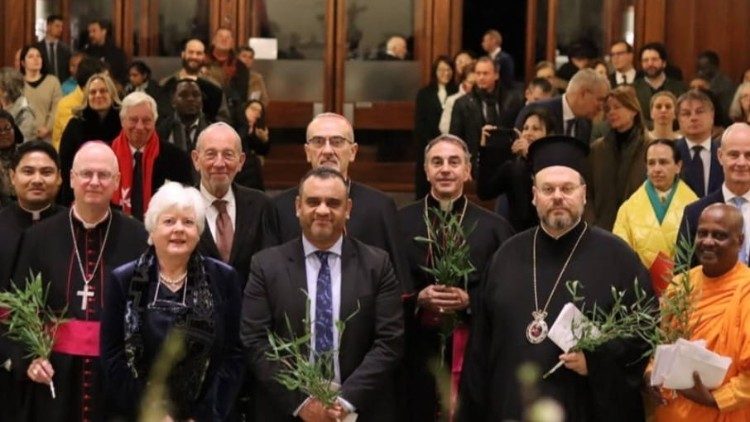
Against a backdrop of escalating conflict and a renewed reliance on the “logic of brute force,” the Holy See’s Permanent Mission to the United Nations in Geneva, led by Archbishop Ettore Balestrero, Apostolic Nuncio and Permanent Observer of the Holy See, hosted its 17th Annual Interreligious Service for Peace on Wednesday, bringing together around 300 diplomats, ambassadors, and religious leaders.
Held at the Church of St. Nicolas de Flüe and co-organised with the Diocese of Lausanne, Geneva, and Fribourg, the service centred on Pope Leo XIV’s 2026 World Day of Peace Message, “Peace be with you all: Towards an ‘unarmed and disarming’ peace.”
Conquering without conquest
In his welcoming remarks, Archbishop Balestrero described the service as a counter-narrative to the logic of violence and conflict.
“An ‘unarmed and disarming’ peace conquers without conquest, and trains not for battle, but for reconciliation and cooperation,” he said, urging diplomats to resist the “weaponisation” of thoughts and words and calling believers to “refute these forms of blasphemy” in which faith is manipulated to justify violence.
A demanding hope
Arriving from Jerusalem, the Latin Patriarch of Jerusalem, Cardinal Pierbattista Pizzaballa, urged the international community to resist resignation in the face of violence.
“Giving up on peace would mean accepting war as the ‘normal language’ in human and international relations,” he said. “To welcome Pope Leo XIV’s message is not naïve optimism, but a demanding hope.”
Reflecting on the Holy Land, he stressed that ceasefires alone are insufficient: “There is no lasting peace without justice, but there is no real justice unless the other is recognised as a person, not a tool or an obstacle.”
The humanitarian imperative
A statement delivered on behalf of ICRC President Mirjana Spoljaric, read by Vice-President Giles Carbonnier, cited the existence of 130 active armed conflicts worldwide and warned of weakening respect for international humanitarian law.
“If there are 100 steps to peace, the first are humanitarian,” the statement said. “Respect for humanitarian law saves lives and preserves pathways back to peace.”
A universal call
Reflections from Christian, Jewish, Muslim, and Buddhist leaders, interwoven with music from the parish’s Filipino and African choirs, highlighted the universality of the Geneva international community and of the Church. The service concluded with the Prayer of St. Francis of Assisi, led by Bishop Charles Morerod of the Diocese of Lausanne, Geneva, and Fribourg.
Thank you for reading our article. You can keep up-to-date by subscribing to our daily newsletter. Just click here.