Archbishop Gallagher: Trust must be rebuilt in a world darkened by wars and divisions
By Daniele Piccini
“Our world is darkened by wars and conflicts, by polarization and deep divisions. In such a climate, hope can seem distant, even elusive.” Yet this hope can be nourished only by the responsibility assumed by each person to “rebuild trust where it has been wounded, persevere in dialogue when it is slow and arduous, and keep open the paths that lead to peace.”
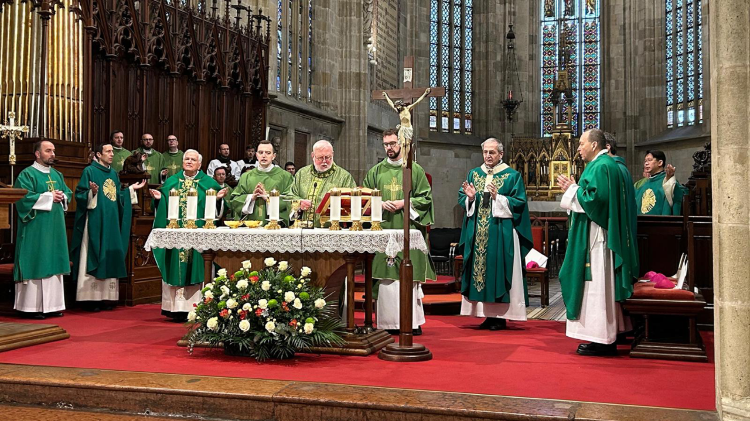
These were the words of Archbishop Paul Richard Gallagher, Secretary for Relations with States and International Organizations of the Holy See, in his homily on Sunday, February 1, in St. Martin’s Cathedral in Bratislava, on the occasion of the 25th anniversary of the Basic Agreement between the Holy See and the Slovak Republic.
The Beatitudes and the logic of trust
With the Sermon on the Mount—the reading of today, taken from the Gospel of Matthew—Jesus introduces a completely new logic into human history. “Before giving commandments, before asking anything of us, the Lord proclaims a blessing,” Archbishop Gallagher emphasized, reiterating that Christ looks above all to “the poor in spirit, the meek, the merciful, the peacemakers, those who hunger for justice, and he says: blessed are you.”
This shift in perspective, he said, revolutionizes the values and priorities of history. “In a world accustomed to measuring life by success,” Archbishop Gallagher said, “by security and recognition, Christ opens another perspective for us. He reveals a way of life shaped not by domination, but by trust; not by self-assertion, but by communion; not by fear, but by hope rooted in God.”
Treaties are bridges to heal divisions, not walls to protect privileges
The Beatitudes, he said, are therefore not a utopia, “a poem detached from reality,” but describe “the movement of grace in history,” codifying the ways in which “God acts where human self-sufficiency comes to an end.”
“God,” the Vatican diplomat continued, “builds where the world sees little on which to build. Belonging to Christ means allowing this logic to shape us, so that humility becomes a place of freedom, mercy a form of strength, perseverance a silent proclamation of hope.”
The vocation to hope
Hope, therefore, is not a feeling but a “vocation to be exercised,” as Pope Leo XIV said, Archbishop Gallagher remembered, in his first Message for the World Day of Peace. The Pope had emphasized that “we must encourage and support every spiritual, cultural, and political initiative that keeps hope alive.”
The very history of Slovakia is a testimony to this “persevering hope,” the prelate underscored. “Slovak faith was not born of ease,” Monsignor Gallagher recalled, “but of patient evangelization, unshakable fidelity, and silent perseverance, as witnessed by countless holy men and women.” Beginning with the patrons of the Slavic peoples, Saints Cyril and Methodius, and Saint Gorazd, bishop and martyr of Prague, who bore witness to this new logic of the Beatitudes and for this reason represent “an example of this journey,” because “they did not rely on force or privilege, but on the patient work of the Word—shaping language, shaping culture, and opening hearts to the Gospel.”
25 Years of the Treaty between Slovakia and the Holy See
The Archbishop observed that relations between the Holy See and Slovakia themselves conform to this attitude of “trust” taught by the Beatitudes.
“In this same perspective,” the Vatican official said, “we can situate the twenty-five years of the Fundamental Treaty between the Holy See and Slovakia. Born of dialogue and mutual recognition, it reflects a shared commitment to serve the human person in all the complexity of contemporary life. By respecting the proper distinction between the spiritual and temporal orders and promoting cooperation for the common good, it safeguards spaces in which conscience is honored, where families and communities are supported, and where religious freedom nourishes the moral and cultural life of society.”
Relations between the two States, he highlighted, thus offer “a framework in which human dignity can be upheld, dialogue can flourish, and hope—founded on faith, charity, and justice—can quietly take root and grow.”
Prayer for Ukraine and all peoples affected by conflicts
Thus, the Vatican's Secretary for Relations with States and International Organizations observed that the day’s Gospel on the Beatitudes “return with renewed clarity,” because they “remind us that peace is never limited to negotiation, but is formed, cultivated, and lived" and "takes root in hearts capable of mercy, in communities willing to seek equitable justice, in institutions that choose dialogue rather than exclusion.”
Archbishop Gallagher concluded by remembering "the suffering peoples of all lands torn apart by violence, in particular Ukraine,” praying that the Spirit may form us “as artisans of peace, capable of sustaining hope even when it seems fragile.”
Thank you for reading our article. You can keep up-to-date by subscribing to our daily newsletter. Just click here.