
Cardinal Zenari reaching age 80 concludes mandate as Nuncio in Syria
By Salvatore Cernuzio
In 2021, upon turning 75 (the canonical age for “retirement”), he submitted his resignation from what for nearly seventeen years had been more than a diplomatic post — a true mission: serving as Apostolic Nuncio in Damascus, representative of the Pope and a point of reference for the universal Church in “martyred” Syria. Pope Francis rejected the resignation and chose to keep him in office “for an indefinite period,” a decision that “Don Mario” interpreted as yet another sign of attention toward the population, wounded by war and poverty and subjected to constant upheavals, that saw in him a stable and authoritative point of reference.
“War veteran”
After five years, however, with reaching age 80 on 5 January, Cardinal Mario Zenari brings to an end his long ministry as papal representative in one of the most wounded territories in the world. His resignation was announced today, February 2, in the bulletin of the Holy See Press Office. Yet, despite the brief institutional notice, lies a great story.
It is the story of a priest from Rosegaferro di Villafranca di Verona, trained at the Pontifical Ecclesiastical Academy and soon becoming a “war veteran,” as he himself defines it, serving as Apostolic Muncio in the early 2000s in Côte d’Ivoire, Niger, and Burkina Faso, and then from 2004 to 2008 in Sri Lanka. In 2008, he set foot in Syria for the first time, following the appointment of December 30 desired by Benedict XVI.
At the time, Syria was entirely different from the one we know today — and that many young Syrians and children know, having known nothing in life other than the misery and horrors of war. It was a country marked by apparent stability and a phase of economic opening, with tourism on the rise, yet crossed by underlying social tensions. In 2011 came the outbreak of the conflict, the uprisings, the ISIS massacres — and Zenari always there, as the Pope’s representative, carrying out diplomatic and mediation work aimed at a peaceful solution to the conflicts, as well as humanitarian efforts of closeness and comfort to people living what he himself often called “hell on earth.”
Denunciations and hardships
Cardinal Zenari never hid the difficulties — even personal ones — experienced in Syria. He did not hesitate to speak of a “humanitarian catastrophe,” of hope that has “died” among the people, especially among the young, even today, despite various political and social changes, at the center of a hemorrhage. He was not afraid to denounce the international oblivion surrounding the conflict, the grip of sanctions on the population, the endemic poverty that forces people to stand in line for kilometers for a piece of bread or to pay for gasoline with a month’s salary.
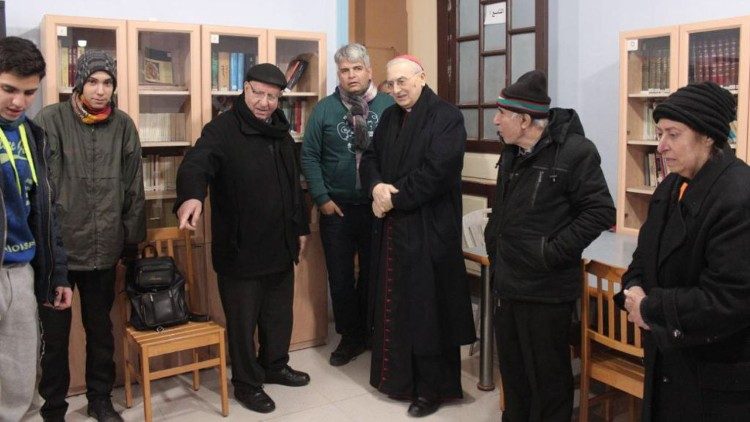
These were strong, but never shouted, statements, which the Cardinal always delivered in a soft tone, with a particular expression on his face through which pain — and also weariness — could be perceived, in seeing all that he had seen. War, bombings, hunger, and also — as if that were not enough — the 2023 earthquake that devastated the northern regions, with Cardinal Zenari immediately driving from Damascus to Aleppo, transporting in the trunk barrels filled with diesel fuel, difficult to obtain.
Cardinal in 2016
From 2016, Zenari carried out his role as Apostolic Nuncio wearing the red zucchetto — bestowed on him by Pope Francis, who created him a cardinal at his third Consistory. At the time, this was an unprecedented decision that in some way broke with the practice of the past century, which had consistently provided that papal diplomats be granted episcopal rank but not the cardinalate, which some of them attained only after a change of assignment.
It was also a novelty in the history of the Eastern Catholic Churches, which for the first time saw the scarlet not conferred on a member of the local episcopate, but on the head of the Vatican’s diplomatic mission. Cardinal Zenari commented on the Pope’s choice with just a few words: “A gesture of love.” “A gesture of love for the martyred Syrian population, but also a gesture of support for diplomacy,” he said.
By granting his envoy the Cardinal’s dignity, the Pope, the nuncio further emphasized, “gives added value to this presence and to the diplomatic efforts aimed at resolving the crisis. I feel encouraged in my service.” Being Cardinal in fact implied Zenari’s permanence in Damascus. Not that he had considered a transfer, as he had said, “How could a representative of the Pope be credible if he fled from where he is most needed? For me this mission is a privilege given to me by God, a deeply moving human experience.”
Cardinal Zenari's stay in Syria lasted far longer than expected, also considering the political complications that replacing the papal representative could entail. In December 2024, he was also able to witness the overthrow of Bashar al-Assad’s government and the emergence of the new leadership led by Ahmad al-Shara.
Thus, with today’s resignation, the mission of a “field nuncio,” a long-serving diplomat and shepherd of a martyred flock, comes to an end.
Thank you for reading our article. You can keep up-to-date by subscribing to our daily newsletter. Just click here.