From human bias to shared space: Shaping a future that is within reach
By Francesca Merlo - Treviso, Italy
On the first full day of the 17th GreenAccord International Forum, conversations moved between two interconnected questions: why we struggle to act on the climate crisis, and what it might look like to build differently - not just environmentally, but socially.
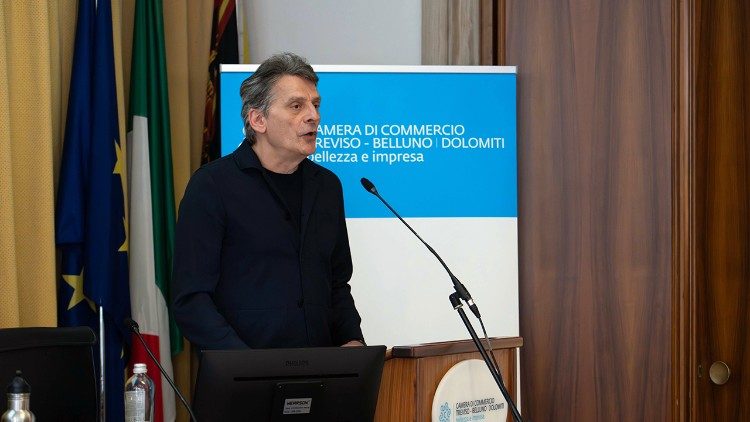
Luciano Canova is an economist specialising in behavioural economics and spoke on this second day of meetingss. He approaches the issue from a simple point: that human beings are actually not as rational as we like to believe.
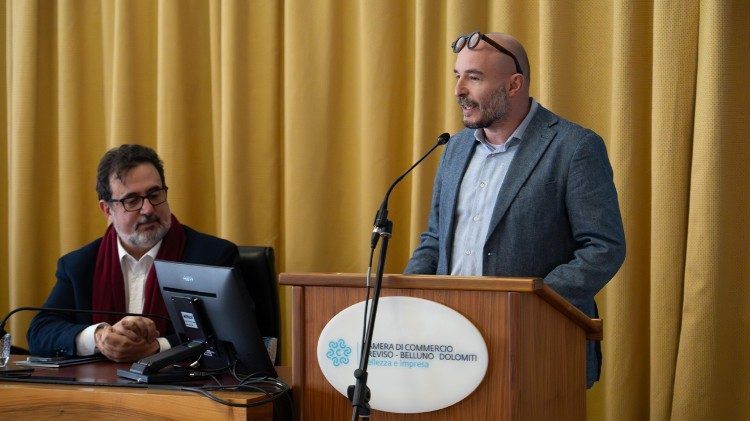
Behavioural economics, he explains, on the sidelines of the events, looks at “the links between psychology and economics…to study the decision-making of human beings,” placing at its centre the idea that “we are limited by our evolution to make judgement mistakes and biases.” In that sense, the climate crisis is “the perfect storm of all the mental traps that apply to our everyday life.”
One of the most significant of these is our relationship with time. “We are very myopic about the future,” he says. “We see pretty clearly what happens today, not that much what happens in, for example, 50 years from now.” The consequences are tangible: if the costs and benefits of climate change feel distant, action becomes easier to postpone. To illustrate this point, Canova turns to something quite simple. He notes that we are all very good at setting an alarm the night before, a commitment to change: to go for that early morning run or walk. When morning comes, that commitment often dissolves and we choose to hit snooze. “Imagine what happens when the analysis goes into 50 years,” he adds.
Distance is also emotional. Climate events that happen far away are harder to relate to. “If floods happen thousands of miles away from here, you cannot identify with victims of climate change,” he explains. Unlike other crises, they remain abstract, lacking immediacy. This combination - distance in time and distance in experience - contributes to inaction. But there is another layer: communication. Canova suggests that the way data is presented can either motivate or paralyse. “We stress a lot what is missing…how far we are from reaching the goal of Paris 2015,” he says, but less attention is given to what is still possible. “Grasping away one-tenth of a degree more of projected augmentation of temperature…is really important,” he insists. Without this sense of impact, individuals risk feeling insignificant in the face of a global problem. “You perceive yourself as useless if compared with the immensity of the problem.”
This is where both moral and political responsibility come into play. For Canova, sustainability is inherently ethical: it requires taking into account “people who are not even here yet, in a hundred years from now.” At the same time, he is clear that responsibility cannot rest on individuals alone. “It’s not people alone who need to solve the problem. It’s collective action,” which in turn requires political accountability.
"Building" a Future Together
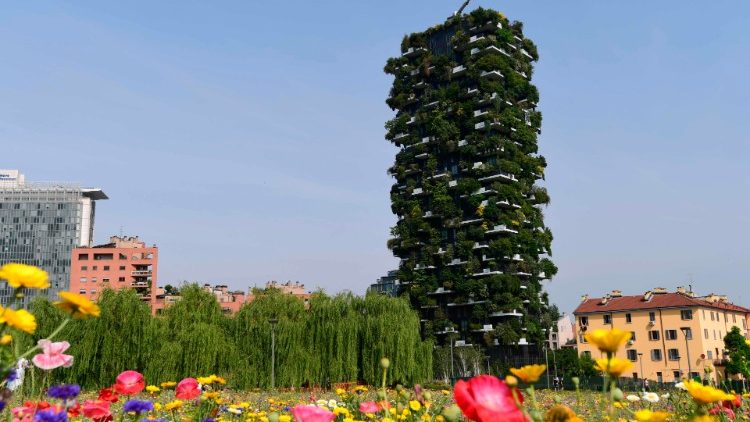
From decision-making to design, Martin Haas, a German architect working in bio-architecture, approaches the same challenge from a different angle - not how we think, but how we live. Asked what the future might look like with Bio-architecture, his answer is: “Positive - a good one.”
For Haas, the current moment is defined by transition. “The world as we have known it has reached a point where we need to address key issues and start thinking differently.” This shift is not only technical, but ethical. It concerns how we use materials, energy, and space - and how we relate to one another. Architecture, he argues, is not neutral. “They shape the world we live in. They influence how we experience spaces, how we share, and how we interact.” As a result, it carries responsibility not only for environmental impact, but also for social behaviour.
One example he offers is a building constructed using rammed earth (a technique that constructs walls by compacting a damp mixture of earth, sand, gravel, and clay). Once associated with poverty, the material is now being reconsidered. In this case, the response from users was striking. “In my 25 years as an architect, I have never worked on a building that received such positive feedback,” he says. Haas recalls that people began reflecting on their own habits - how they used energy, how they thought about materials, even how they lived.
The building itself avoids complex technical systems and relies on passive solutions, operating “at the edge of comfort.” That slight discomfort, Haas suggests, can prompt awareness - encouraging people to reconsider everyday actions. Yet sustainability, in his view, begins even earlier than design. “Before anything else, we must ask a simple question: is the building actually needed?” In a sector often driven by profit, this question is rarely prioritised, instead we should be building less and building better.
What follows is a different model, centred on sharing. Haas points to projects where facilities are communal rather than duplicated - kitchens, laundry spaces, and social areas designed for interaction rather than isolation. In urban contexts, this becomes even more relevant. Many people, he notes, are searching for connection. Cities, however, often offer spaces defined by consumption. His response is the idea of non-commercial “third places”: environments “where you can be among others, yet still have your own space,” without the expectation to spend.
These spaces, combined with practical considerations such as shade, air quality, and human-scale design, can reshape how people experience cities. There is also, he adds, something to be learned from the past. Before energy was widely available, buildings were designed in response to climate and context. People were living, and living well, in the homes they built. “Looking back is not a bad idea,” he says. While technologies have changed, “what hasn’t changed is the human scale - how we relate to space and distance.”
Taken together, the perspectives of Canova and Haas highlight two sides of the same challenge, both pointing to the need for a change that is not only technological, but cultural. Bridging that gap, between how we think and how we build, as these conversations suggest, may help to build the future for those who are yet to come.
Thank you for reading our article. You can keep up-to-date by subscribing to our daily newsletter. Just click here.