Sr. Petrini: 'Future of work doesn't lie in machines, but in humanity's moral decisions'
By Deborah Castellano Lubov
"Ultimately, the future lies not in machines, but in the moral choices of humanity."
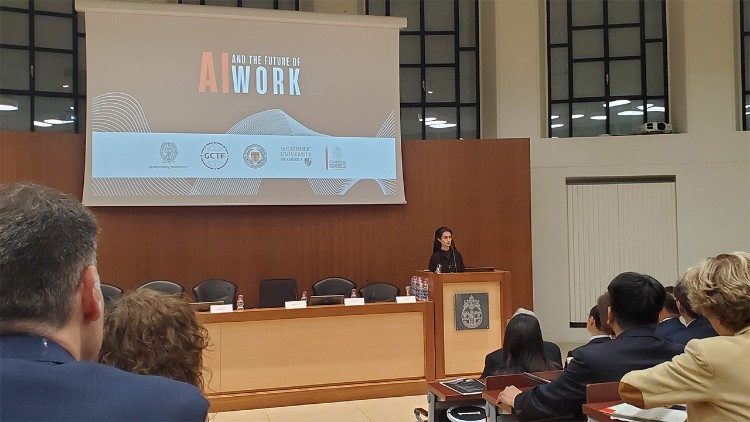
This key reminder was expressed by Sister Raffaella Petrini, President of the Governorate of Vatican City State, during a high-level conversation on "AI and the Future of Work" held Tuesday morning at Rome's Pontifical Gregorian University.
The event, convened by the U.S. Embassy to the Holy See and co-sponsored by the Australian, British, Canadian, Japanese, Taiwan, and United States Ambassadors to the Holy See, along with Georgetown University, the Catholic Institute of Technology, and the Catholic University’s Leonum Institute for AI & Emerging Technology, brought together leading voices to explore the frontiers of artificial intelligence and the future of work.
The dialogue convened technology creators, theologians, ethicists, regulators, policymakers, academics, and civil society to discuss AI and the future of work, and our shared responsibility to shape that future.
Sister Petrini reflects on a 'crucial crossroads'
In her keynote, Sister Petrini observed that AI is a transformative force that necessitates a shared responsibility.
"In today's era of profound innovation, AI offers enormous potential, but also brings us to a crucial crossroads," she said, stressing that "choices must be made in order to ensure that this technology serves the interests of all humanity, always prioritizing human and social values above all else."
The President of the Governorate of the Vatican City State observed that work is one of the most important targets of these choices, "not only because the Church believes it is a fundamental dimension of man's existence on earth, but also because independently of its objective content, it is a dimension that allows a person to realize his or her humanity."
"In other words, work," she explained, "enables a person to fulfill his or her calling as a human being," as she acknowledged that we are in an age where artificial intelligence is redefining work and communication."
Reshaping the labor market: creating opportunities, but also new forms of exclusion
She then posed the question: what does it mean to be human in an increasingly automated world?
"Artificial intelligence is actually more than a tool. It is a transforming force," she emphasized, acknowledging that "automation and the increasing use of intelligent systems are reshaping the labor market, creating new opportunities but also new forms of exclusion."
The Vatican official drew the attention of those before her to some positive developments of the technology revealed in the International Labour Organization's report titled "Revolutionizing health and safety: The role of AI and digitalization at work."
Their research, she acknowledged, that "this digitalization and automation can significantly reduce exposure to hazards, prevent workplace injuries, and improve overall work conditions," which “enhances not only workplace safety and health, but also the way in which it is monitored."
"Yet," she likewise warned, "potential risks such as excessive surveillance, work intensification, as well as physical and psychosocial challenges may arise."
Sister Petrini recalled that the ILO has called "for a proactive, evidence-informed, and participatory approach to mitigate such risks."
Further reflection on the consequences of technological change on skilled and unskilled workers has argued that the effects of automation can be seen in the form of complementarity or substitution.
Technology meant to serve humans, not to replace
Technological change, however, is also strongly influenced by institutional decisions.
She noted that many experts emphasize that technology is meant to serve people, not replace them, and have called for an alliance between humans and technology that is grounded in responsibility, cooperation, and education.
"Artificial intelligence can be a very useful way of learning, a way of perceiving, if guided by a vision or a tool," she said.
Stressing the need to be guided by a vision that puts the human person at the center, which implies a shared responsibility, she spoke on the role of governments.
"Governments," she noted, "are called upon to regulate, governments to innovate conscientiously, educators to train informed citizens, and each of us to use technology critically and responsibly."
'We must not fear AI, but not simply accept it'
She made the point that if we believe that a person made in the image of God is always the subject of any kind of work, then international cooperation is necessary to promote an eternal vision of progress, not just the technical one.
In this context, she called for technological development not to abandon human, cultural, and spiritual development.
"We must not fear AI, but not simply accept it blindly," Sr. Petrini said, acknowledging that even if some researchers claim that machines can and should be held to ethical standards so that respectful and virtuous AI can be developed, more action is needed.
"Ultimately, the future lies not in machines, but in the moral choices of humanity," she insisted. "We have the capacity and responsibility to decide whether this new technological era, in every field, will usher in an era of greater justice and solidarity or new inequality."
After having also shed light on how the Vatican is concretely taking seriously the field of artificial intelligence, she said, "Artificial intelligence is a reality that will continue to have a profound effect on human actions, including work of course, from a professional and social point of view, but its trajectory is not predetermined as it reflects the choices, values and interests of those who design and implement it."
Programme of experts, leaders, and policymakers
The discussion's program opened with a call to order by Laura Hochla of the U.S. Embassy to the Holy See, followed by welcome remarks from Father Mark Lewis, Rector of the Pontifical Gregorian University, who said the theme of the discussion requires serious thought and consideration.
"Stressing that ethical values should be considered in how artificial intelligence is employed," the Rector stated, "it now falls to us," also in determining how to best prepare the pontifical university's students.
Anthony CY Ho, Taiwan Ambassador to the Holy See, presented "The Global Cooperation and Training Framework Presentation – A Multistakeholder Discussion," reminding those before him that AI raises important questions about ethics, work, and human dignity, but stressed that, "As Pope Leo says: AI must serve humanity, not the other way around."
He also joked that his remarks were not AI-generated.
Next, U.S. Ambassador to the Holy See, Brian Burch, reflected on "Why Are We Here – A Call for Humility," calling artificial intelligence "a defining issue of our time," that necessitates "a shared responsibility." When discussing AI and its effect on work, the U.S. Ambassador to the Holy See noted it is not "abstract," but "practical and urgent."
Further perspectives were offered by Éric Salobir of the Human Technology Foundation, who presented "A Synthetic View: AI and the Future of Work."
While recalling that a 2025 Gartner HR Survey found that 65 percent of employees are excited to use AI at work, there are also common fears employees have about the technology, namely job displacement, inaccuracy, transparency, reputation, and data insecurity.
Expert on the phenomenon, Father Paolo Benanti of the Pontifical Gregorian University, explored "A Theological View: The Flourishing Worker and the Dignity of Work," who recalled that Christian principles emphasize that a person is defined by who they are, not what they produce.
Thus, Fr. Benanti reiterated that we are not meant to refuse technology, but see it as a supplement, and not reduce workers to cost variables. Ultimately, the human person, with their inherent dignity, must be kept at the center, he said.
How to acquire expertise in the AI age
Noam Yuchtman of the London School of Economics next gave a reflection on "An Economic View: The Future of Workers and the AI Economy."
Those whose work will be complemented by AI, he said, are individuals with expertise, and individuals in positions demanding accountability, whether legal, moral, or economic. The challenge with expertise nowadays, however, he suggested, is "how to acquire this in the AI age."
He said that "We, as individuals, citizens, educators, managers, and policymakers, have a dual mandate: first, to cultivate skills that allow us to develop and utilize AI, and second, to continue to invest in those skills that are deeply human and social."
The session concluded with a closing keynote by George Osborne of OpenAI, who acknowledged that statistics show 18 percent of jobs are at real risk due to artificial intelligence, and that for the foreseeable future humans will continue to be needed to fulfill various roles in the world of work.
"The better question," he said, "is how will tasks and jobs change."
Thank you for reading our article. You can keep up-to-date by subscribing to our daily newsletter. Just click here.