We have much to learn from our persecuted brothers and sisters in Africa
Vatican News.
The theme of the Jubilee Catechesis was, “To hope is to bear witness - Isidore Bakanja.”
Blessed Bakanja is the patron of the Congolese laity and the youth. Pope Francis cited Bakanja as a model of faith for young people in his apostolic exhortation, Christus Vivit.
Perseverance in the faith
Speaking during last Saturday’s Jubilee Audience Pope Leo XIV invited all Christians to persevere in faith in spite of persecution or rejection:
“Dear Brothers and Sisters, as we continue our Jubilee Catecheses, let us reflect today on the life of Blessed Isidore Bakanja, a Congolese martyr who lived out his faith with joy and authenticity, even in hostile environments such as his workplace. The supervisor of the European-owned plantation where Isidore worked despised the Catholic missionaries who defended the rights of the indigenous, and unleashed his anger upon Isidore. This courageous young man continued to manifest his faith, expressing his devotion to the Blessed Virgin Mary by wearing his brown scapular. While close to death due the abuse he suffered, Isidore declared that he would pray for his aggressors from heaven. His testimony reminds us that we have much to learn from our persecuted brothers and sisters in Africa. Let us strive to follow his example of perseverance in the faith despite any persecution or rejection we may face. Blessed Isidore, pray for us, so that we too can give witness to our faith with courage and enthusiasm!”
Who was Blessed Bakanja?
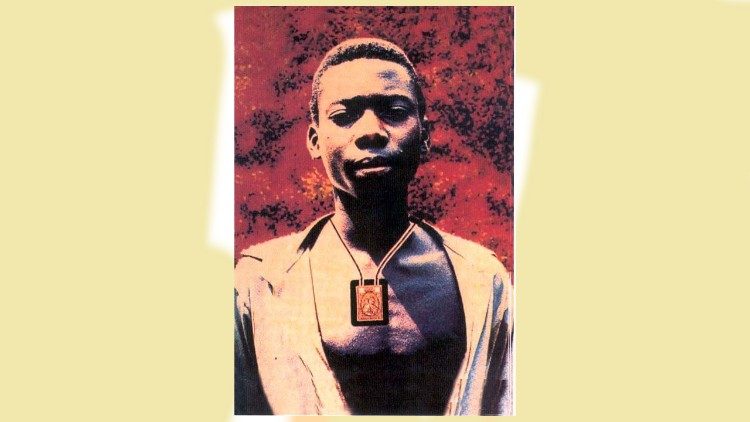
According to the Carmelites, Blessed Isidore Bakanja, a member of the Boangi tribe, was born in Bokendela (Democratic Republic of Congo) between 1880 and 1890. In order to survive, even as a young boy, Blessed Isidore had to work as a bricklayer or on farms. He converted to Christianity in 1906 at the age of eighteen due to his contact with Cistercian (Trappist) missionaries.
Courageous witness on the Plantation
Blessed Isidore, a gifted Catechist, was working on a rubber plantation in Ikili, run by a colonialist, and was forbidden by the owner to spread Christianity among his fellow workers. He was commanded to stop teaching them to pray with his boss remarking: ‘You’ll have the whole village praying and no one will work!’
Martyrdom for the Faith and the Scapular
On 22 April 1909, the superintendent of the business tore off the Brown Scapular, which Isidore was wearing as an expression of his Christian faith, especially of his devotion to Mary, and had him severely beaten even to drawing blood. Blessed Isidore died, Rosary in hand and wearing the Brown Scapular of Our Lady of Mount Carmel, on 15 August of the same year as a result of the horrific wounds inflicted on him in ‘punishment’ for his faith.
Forgiveness and last words
He said to one of those who visited him in his last days: “If you see my mother, or if you go to the judge, or if you meet a priest, tell them that I am dying because I am a Christian.” Blessed Isidore bore his sufferings patiently, all the while forgiving his aggressor. As he lay dying he kept saying: “When I am in heaven, I shall pray for him very much.” Much like Saint Thérèse of Lisieux, Blessed Isidore wanted to spend his heaven doing good on earth.
He was beatified by Pope Saint John Paul II on April 24th 1994.
Thank you for reading our article. You can keep up-to-date by subscribing to our daily newsletter. Just click here.