Cardinal Ferrão at COP30: Halt distractions, phase out Fossil Fuels
By Francesca Merlo
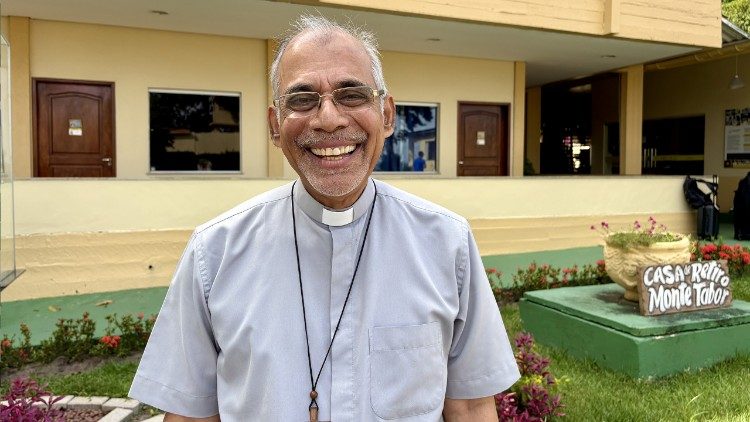
Cardinal Filipe Neri Ferrão, Archbishop of Goa and Daman and President of both the Conference of Catholic Bishops of India and the Federation of Asian Bishops’ Conferences (FABC), is in Belém for COP30, where Churches of the Global South have presented a joint document outlining what they describe as a “moral and spiritual framework” for addressing the climate crisis.
Speaking to Vatican News on the sidelines of the UN's Climate Conference, Cardinal Ferrão said the document was “well received” for its strong call to maintain the 1.5°C global warming limit and for grounding climate action in the Church’s teaching on integral ecology.
“It highlights the relationality between the Creator, creation, and human beings,” he explained, adding that ecological conversion must involve “the heart, the mind, the soul, and socio-economic and political structures” to respond to “the cry of the earth and the cry of the poor” - including Indigenous peoples, migrants, and women and girls.
Wealthy nations and ecological responsibility
During a symposium of Global South Church leaders in Belém, the Cardinal noted that Asia is “on the frontline of ecological and economic injustice.” He reiterated that wealthier nations, which have contributed most to the climate crisis, carry a clear moral responsibility.
“They must pay their ecological debt,” he said. “That means leading the fossil-fuel phaseout, achieving carbon neutrality, and adhering to their climate-finance commitments.”
He emphasised that finance should take the form of grants and public funding for loss and damage, rather than loans, and should support adaptation, capacity building, and technology transfer to poorer nations.
A critique of green capitalism
Cardinal Ferrão also raised concerns about what he called “activist economies and green capitalism,” noting that certain proposed solutions allow major polluters to avoid real change.
“We need clear timelines and targets to phase out fossil fuels,” he said. “We must halt distractions such as bridging fuels, carbon-capture technologies, and carbon trading.”
He explained that the transition to renewable energy must be just, protecting workers and communities who depend on the fossil-fuel sector through retraining and social protection.
Indigenous sovereignty and the role of women
The Global South document also calls for the protection of Indigenous lands and the recognition of Indigenous knowledge in climate-resilience strategies.
“Forests must be protected, and Indigenous tenure rights guaranteed,” Cardinal Ferrão said. He added that women - who are disproportionately affected by environmental degradation - must be heard through documentation of their priorities, equal access to land, training in sustainable practices, and zero tolerance for violence.
Climate finance and unresolved commitments
Reflecting on recent UN reports showing that climate-finance commitments remain unmet and are often replaced by loans, the Cardinal pointed to the Church’s long-standing appeal for debt cancellation.
“I fully agree with the call of Pope Francis and Pope Leo to cancel the debt,” he said. “The North has grown rich by exploiting the South. It is time they repay by cancelling the debt.”
Asia’s climate reality
Asked about the concrete impact of climate change on his region, the Cardinal pointed to the rapidly escalating frequency of extreme weather events.
“Asia is warming at twice the global average,” he said. “Heatwaves, typhoons, droughts, floods, cyclones, sea-level rise, and melting glaciers are becoming more intense and frequent.” He noted that such events deepen existing socio-economic vulnerabilities, especially among marginalised communities.
Pope Leo’s message to the Global South
Cardinal Ferrão also welcomed the recent video message sent by Pope Leo to cardinals and bishops of the Global South participating in COP30.
“We were encouraged by the Pope’s words,” he said. “He reminded us that creation is crying out through floods, droughts, storms, and heat, and that one in three people lives in great vulnerability.”
The Pope’s message, he added, reinforces the need for urgent, collective action.
Violence in New Delhi and the call for dialogue
Finally, reflecting on the recent terrorist attack in New Delhi, which killed at least 10 people and injured 32 others, the Cardinal said the tragedy highlights the importance of interreligious dialogue across Asia.
“Violence often stems from social, economic, and political injustice,” he said. “Dialogue, understanding, and consensus - not violence - must guide coexistence.”
He concluded that in Asia, where Christians are a small minority, interreligious dialogue “is not an option; it is imperative. It is a way of life.”
Thank you for reading our article. You can keep up-to-date by subscribing to our daily newsletter. Just click here.