Philippines: Diocese of Calapan begins a new chapter
By Fr. Kasmir Nema, SVD and Kat Galdo Diaz, Calapan City
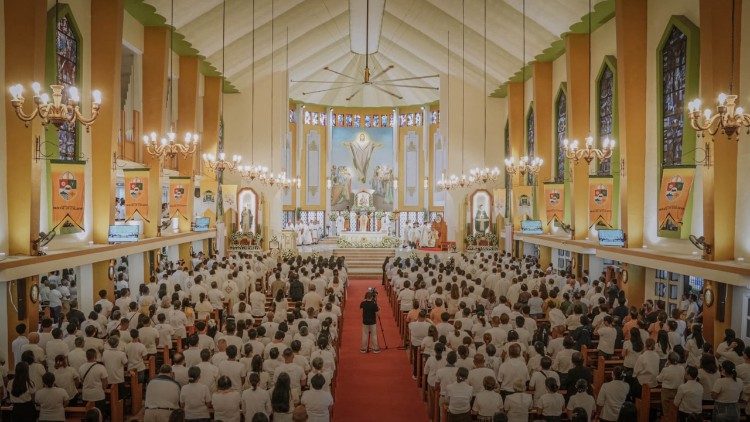
Amid torrential rain and a magnitude 5.8 earthquake, the Catholic faithful of Oriental Mindoro gathered on 7 August to witness a historic moment in the life of the Church: the canonical establishment of the Diocese of Calapan and the installation of its first bishop, Most Rev. Moises M. Cuevas, D.D.
The celebration marked the culmination of nearly nine decades of missionary accompaniment and pastoral growth, as a community once entrusted to missionary care now assumes its identity as a fully established local Church.
Located on the island province of Oriental Mindoro, approximately 180 kilometres from Manila, the Diocese of Calapan has been shaped by the geographical realities of island life. Reaching many communities requires long journeys—around three hours by land and up to another three hours by sea—especially to areas where generations of missionaries have brought pastoral care, education and social support.
With the creation of Calapan as a diocese, the Catholic Church in the Philippines now comprises 16 archdioceses, 60 dioceses, four prelatures, one military ordinariate and six apostolic vicariates.
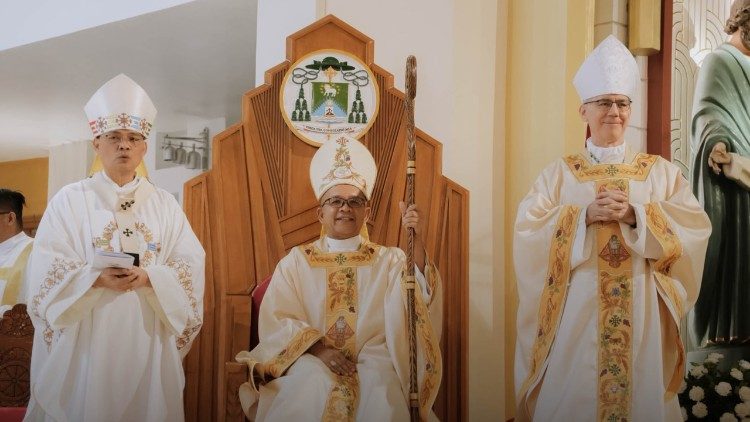
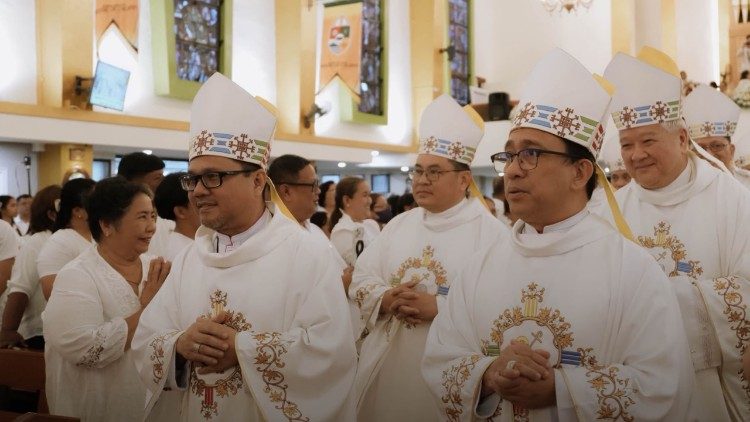
The Mass of Canonical Erection and Episcopal Installation was presided over by Archbishop Charles John Brown, Apostolic Nuncio to the Philippines. He was joined by Archbishop Gilbert A. Garcera of Lipa, president of the Catholic Bishops’ Conference of the Philippines (CBCP), around thirty bishops, priests, religious men and women, and hundreds of lay faithful.
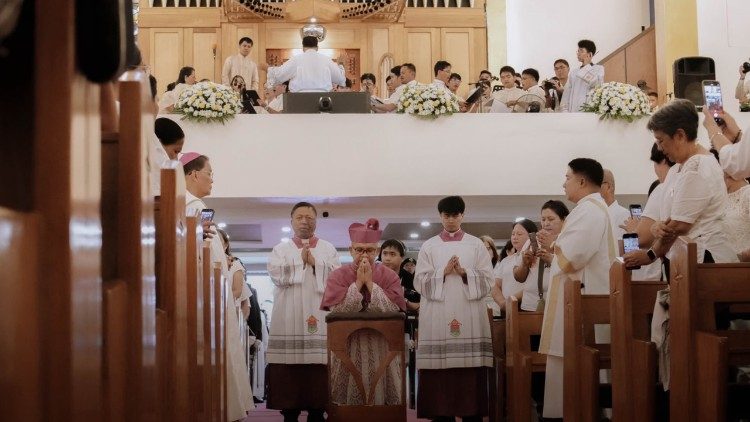
At the entrance of St. Benedict Cathedral, Bishop Cuevas was formally welcomed by the diocesan community. He venerated the crucifix and sprinkled the faithful with holy water, a gesture expressing his commitment to serve as shepherd of the newly established diocese.
During the liturgy, Fr. Nestor Julao Adalia, outgoing Apostolic Administrator, proclaimed the Papal Bull establishing the Diocese of Calapan and appointing Bishop Cuevas as its first diocesan bishop. Archbishop Brown then led Bishop Cuevas to the cathedra, the bishop’s chair symbolising his ministry of teaching, sanctifying and guiding the People of God.
“A missionary community sent to proclaim Christ”
In his first homily as diocesan bishop, Bishop Cuevas reflected on the long journey of faith that brought Oriental Mindoro to this historic moment.
“Becoming a Diocese is not simply an institutional change,” he said. “It is a call to further expand the mission of Christ, deepen our faith, serve the poor, guide the youth, accompany the Mangyan people, defend the dignity of every person and family, uphold justice and peace, and care for our common home.”
He invited the faithful to embrace their vocation as a missionary community rooted in communion.
“With the light and strength of the Holy Spirit, let us build a Church—a sign of unity, a missionary Church,” Bishop Cuevas said.
During the Eucharistic celebration, a magnitude 5.8 earthquake struck neighbouring Occidental Mindoro. The tremor was felt inside the cathedral, but the congregation remained calm and the Mass continued.
For Bishop Cuevas, the moment was a reminder that the Church’s mission continues amid the realities and challenges of everyday life.
“Becoming a Diocese means being more fully sent out as a missionary community, journeying together under the guidance of the Holy Spirit,” he said.
The words captured the deeper meaning of the celebration: a community formed through decades of missionary presence is now called to take greater responsibility for evangelization and pastoral service.
A journey shaped by missionary witness
The history of the Diocese of Calapan traces back to 1936, when the Holy See established the Apostolic Prelature of Calapan and entrusted its pastoral care to the Society of the Divine Word (SVD).
Bishop William Finnemann, SVD, became the first Apostolic Prefect and laid the foundations of missionary work in Oriental Mindoro. His successors continued the mission of accompanying the people through evangelization, education and social development.
In 1951, Pope Pius XII elevated the prelature to an Apostolic Vicariate and appointed Bishop Wilhelm Josef Duschak, SVD, as its first Apostolic Vicar. He was later succeeded by Bishop Simeon Valerio, SVD, as SVD missionaries continued strengthening the young Church.
Their missionary commitment included a particular concern for the Mangyan Indigenous communities, accompanying them in their search for a dignified life while responding to challenges related to poverty, natural disasters and environmental protection.
A new phase began in 1997 with the appointment of Bishop Warlito Cajandig, the first bishop born in Oriental Mindoro. During his 27 years of episcopal ministry, he promoted Basic Ecclesial Communities, strengthened disaster preparedness programmes and developed a close relationship with Mangyan communities.
After Bishop Cajandig’s death, Bishop Moises Cuevas was appointed Apostolic Vicar of Calapan in 2023. He guided the community during the final stage of its transition from apostolic vicariate to diocese.
In March 2026, Pope Leo XIV elevated the Apostolic Vicariate of Calapan to a diocese, recognising the spiritual maturity and pastoral growth of a Church community that had been nurtured through decades of missionary dedication.
Carrying the missionary legacy forward
For the faithful of Oriental Mindoro, the Diocese of Calapan represents both a blessing and a responsibility. It is the fruit of the commitment of missionaries, clergy, religious and lay people who patiently planted and cultivated the seeds of faith.
The establishment of the diocese does not mark the end of its missionary history. Rather, it invites the people of Calapan to continue that mission in a new way: proclaiming the Gospel, accompanying the poor and Indigenous communities, caring for creation and building communion within society.
From its missionary roots, the Diocese of Calapan now begins its journey as a local Church—grateful for the past, committed to the present and open to the future that the Holy Spirit continues to guide.
Thank you for reading our article. You can keep up-to-date by subscribing to our daily newsletter. Just click here.