Pope to religious: Avoid 'stagnation' in governance, inspire hope in your brothers
By Isabella H. de Carvalho
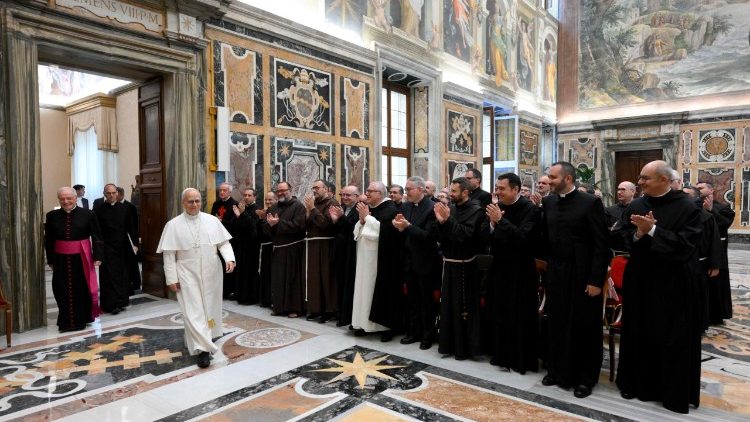
Pope Leo XIV met with participants in the 65th General Assembly of the Italian Conference of Major Superiors (CISM) at the Vatican on Friday, November 7.
In his address, the Pope highlighted how synodality can help them in their mission and governance, in order to avoid “self-referential tendencies” or “stagnation” and to inspire hope in the other religious members.
The Pope’s speech reflected on the theme of the General Assembly, which is “Governing Hope: Forms and styles of governance in the Provinces of a synodal Church.”
"The community of believers has never shied away from the stimuli or challenges of the times and places in which it has lived,” he said, adding that the Church seeks to continue to do so today, in order to bring “Christ's message to every area of society and every part of the world.”
He said the presence of religious has always been “significant and providential” in this mission, and the Major Superiors’ choice of theme for the General Assembly demonstrates their “commitment to this role,” especially in the context of the synodal journey that the Church has embarked on in the last years.
Importance of discussions, sharing and fraternal correction
Pope Leo referred to the Final Document of the XVI Ordinary General Assembly of the Synod of Bishops, released in October 2024, to emphasize certain guidelines that can help religious communities in their governance.
He underlined as “interconnected processes" three important attitudes: “ecclesial discernment, care for decision-making processes,” and “the commitment to accountability and the evaluation of our decisions.”
“Fidelity to the Church guides and enlightens the involvement of the brothers, and it nourishes their co-responsibility, ensuring transparency and fostering that mutual openness which alone can promote the cooperation of all,” he continued.
“Sincere discussion, sharing, and fraternal correction can greatly help to avoid and counteract any particularistic and self-referential tendencies,” he said.
Pope Leo also emphasized the importance of having a regular and “fruitful rotation of responsibilities and offices,” in order to avoid “forms of stagnation that risk fostering rigidity and sclerosis.”
“Ultimately, it is a journey of purification,” the Pope said, adding that the aim is to make “individuals and communities increasingly free in goodness, both in terms of personal growth and the exercise of charity.”
He said this favours “a renewed charismatic fidelity” that strips away “structures and attachments that are non-essential or even harmful” to the original missions proposed by the founders of the various religious congregations.
Ministry of authority can inspire hope
Pope Leo pointed out that the Final Document of the Synod on Synodality insisted on how throughout history many forms of consecrated life elaborated what are now recognized as practices of synodal living, such as learning to “harmonize together individual gifts as well as pursue mission in common.”
“Synodality, which is intrinsic to the life of the Church, is all the more proper to your vocation; this makes you particularly suited to contribute to the efforts being made throughout the world in this regard,” the Pope said.
He also emphasized “the growing interculturality of consecrated communities,” which reflect the diverse societies of today’s world.
Pope Leo warned, however, that the wealth formed by these aspects that represent consecrated life should not be considered “definite and static.”
“It is the result of a dynamic life and faith that constantly needs to evolve, grow, develop, and express itself, both in the multiplicity of charismatic contexts and in the continuous novelty of situations and relationships,” the Pope said.
For this to happen, he said, these aspects need to be taken care of like “the fruit of a living organism, in need of nourishment, attention, and sometimes even healing.”
“The ministry of authority can contribute significantly to this, with forms and styles of ‘government’ suited to inspiring hope in the journey of our brothers, supporting their generous and fruitful apostolate,” the Pope said.
In conclusion, Pope Leo quoted St. Augustine, who in his Soliloquies answers the question—“Why do you desire that those men whom you love should live with you, or should live at all?"—with: “in order that we may together inquire into God and our own souls. For thus, he who first found out something could, without labor, easily impart it to the others.”
This important thought, said the Pope, helps them reflect on “the synodal dimension of the responsibility we have towards our brothers.”
Thank you for reading our article. You can keep up-to-date by subscribing to our daily newsletter. Just click here.