Tech expert: People are in need of moral leadership on AI
By Isabella H. de Carvalho
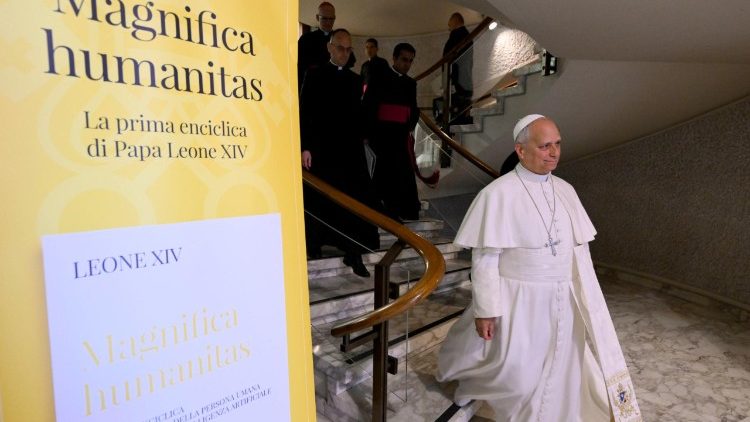
“The world is deeply in need of moral leadership” on the issue of artificial intelligence, American tech expert and entrepreneur Eli Pariser told Vatican News, a couple of days after the publication Pope Leo XIV’s first encyclical Magnifica humanitas, on safeguarding the human person in the time of artificial intelligence.
“Right now, the people who are leading it are so frenzied by the technological race and the money that's at stake that they're really not spending enough time thinking about the deep ethical and moral questions,” he continued.
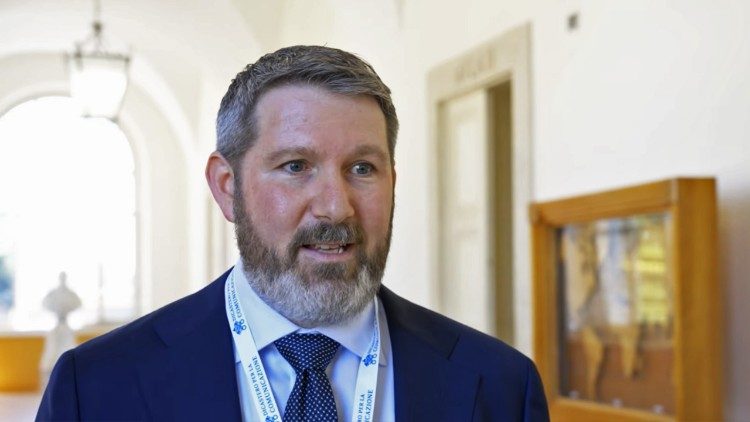
Pariser has been speaking, reflecting and writing on the risks and potentials of various digital and technological developments for over a decade.
He began by promoting online citizen engagement, then in 2011 he warned of the dangers of a hyper-personalized internet by coining the term “filter bubbles,” systems that selectively present information to users through algorithms or personalized searches.
Today he is the co-director of New Public, a nonprofit dedicated to building healthy and thriving digital public spaces, and is focusing on the impact of artificial intelligence. On May 21 he participated in a conference organized by the Vatican’s Dicastery for Communication on the need to preserve human voices and faces in the age of AI.
In an interview with Vatican News, Pariser spoke about the impact that the encyclical is having in tech circles and beyond, and commended the Pope’s view that there is still time to develop AI in a way that benefits humanity.
“I'm very grateful to the Pope and the Vatican for leading the conversation and reminding people that at the end of the day, this has to be about human dignity and human flourishing and not about technology,” he emphasized. “It is anthropological, not technological.”
A document with a wide reach and longevity
For Pariser, Magnifica humanitas could not have come at a better time: “While the AI conversation has been growing, I think a lot of people are realizing now that it’s not just hype, it’s not just a bubble, there’s something real and important going on.”
“On the one hand the encyclical speaks to those who are building the technology," he said, "but on the other it speaks to a much broader audience of people who are realizing how impactful this technology is going to be in the future of all our lives".
Media outlets from all over the world have written about the Pope’s encyclical and Pariser confirmed that the document is being widely discussed online, in community groups and amongst AI developers and tech experts.
In the week of the encyclical’s publication, Pariser said it had been “one of the top conversations universally in every technological space” he had participated in. “People have been annotating it, discussing it, pulling it apart, debating it.”
Pariser defined it as a “brilliant and effected way” to get people to actually think and reflect on the moral and spiritual dimensions of AI and its development.
He also underlined that, because of the topics it focuses, he believes “it’s going to be a document that has some longevity.”
“There's so much in there that is important and that is clarifying. That may not be directly relevant to particular people today, but maybe tomorrow or down the road,” Pariser said.
An AI that brings people together, not pushes them apart
Pope Leo XIV begins his encyclical by underlining that when it comes to artificial intelligence humanity is “facing a pivotal choice: either to construct a new Tower of Babel or to build the city in which God and humanity dwell together.”
Pariser said he appreciated the reference to the Tower of Babel as a “reminder of the dangers of hubris and human overreach in what we build” and noted that this analogy also highlights “the need to protect both what makes humans special and unique and our great diversity as a group.”
When it comes to AI, “His Holiness is not saying that the choices are just to stop everything and roll back to a previous era or move forward” but rather that “we have to choose how we want AI to serve us,” Pariser explained.
Along this same line of reasoning, Pariser underscored that AI can take different forms - it can either be a “pro-social AI that knits people together” or a “parasitic AI that captures people's attention and cannibalizes their relationships.”
“A simple example of that is if you're lonely, either your chatbot can say, ‘I'll be your friend’, or it can say ‘the way to make friends is to get involved in a local group, here are some local groups near you that relate to your interests,” Pariser continued. “I think those point in really different directions in terms of the effects on society.”
Pariser underlines how many feel a “sense of helplessness” when it comes to AI but he insists that this technology “is still very much in the early stages” and so we can shape what it will become.
“There’s no reason this technology couldn’t help people,” even in understanding how to judge what kind of content on the internet is truthful or not, Pariser reflected.
For him it is a question of “incentives”: “If your chatbot is working for you and wants to scrutinize what's coming across your screen to help you see where it's coming from and what's well-sourced and what's not, that's achievable. But if it's working for someone else who wants to influence you or make you believe something or reinforce your own incorrect beliefs, that's very easy also.”
“It’s our job as a society to decide how to structure them and how to use them and in which context,” Pariser emphasized.
Start taking control
In Magnifica humanitas, Pope Leo XIV also talks about “disarming AI”, or “freeing it from the mentality of ‘armed’ competition” and preventing it from dominating humanity.
Pariser agrees that AI is being developed in “an atmosphere of intense economic competition and capitalistic maximization.”
“We know from social media and from other experiences that we've had with technology that when people are optimizing just for what makes an economic return, often that has really harmful effects for people and communities,” he insisted, adding that he appreciated the encyclical highlighting this point.
Pariser also noted that, unlike social media, which relied heavily on advertising as a business model, AI companies are trying to generate revenue in different ways; for example, Anthropic is focusing on enterprise users.
“There’s a lot of leeway here to shape things differently," Pariser stressed, "if we can get out of that feeling of helplessness and start taking control."
Thank you for reading our article. You can keep up-to-date by subscribing to our daily newsletter. Just click here