Vatican: Altarpiece installed in the Church of the Teutonic Cemetery
By Gudrun Sailer
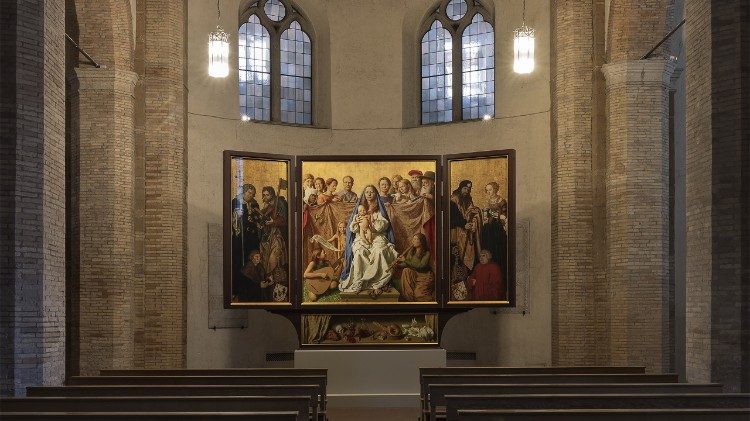
In a quiet corner behind the Vatican walls, beside the tomb of St Peter, an event rich in symbolism has taken place. A large altarpiece has arrived from Naumburg, in eastern Germany, to be displayed in the Church of the Teutonic Cemetery (Campo Santo Teutonico). Created by painter Michael Triegel, the work bridges five centuries of art and faith — and now stands only a few steps from the grave of one of its unlikely protagonists: a German homeless man who unknowingly became the model for the figure of St Peter.
When Triegel, a Catholic artist from Leipzig, turned fifty in 2018, he encountered the man — known simply as Scheffler — outside a church in Rome’s Trastevere district. “I realised,” the artist told Vatican media, “that by giving him alms I was trying to buy a clear conscience. But then he looked at me. In those eyes, there was an entire life.” Triegel asked him to pose, painting him from below — “as one does with emperors and popes.”
The face of Peter
That same face reappeared in 2020, when Triegel painted an altarpiece for Naumburg’s Evangelical Cathedral, incorporating fragments that remained from an unfinished work by Lucas Cranach, the great painter of the Reformation. In the composition depicting the Madonna and Child surrounded by ten saints, the Apostle Peter bears the features of Scheffler, the beggar from Trastevere.
Now, in a striking turn of events, the painting has been installed beside Scheffler’s own grave in the Teutonic Cemetery. After his tragic death from exposure under St Peter’s colonnade in 2022, he was laid to rest there, welcomed, though a Lutheran, in the burial ground for pilgrims overseen by the German Archconfraternity that maintains the site.
“For me, this borders on the miraculous,” Triegel said, recalling the controversy surrounding the painting’s removal from Naumburg’s Cathedral due to heritage restrictions linked to its UNESCO status. “I admit, at times I felt discouraged and thought no one was speaking anymore about what we wanted to convey. But now, knowing that this poor man — who died of cold in wealthy Europe — has a name and is remembered, I feel the entire Naumburg project has found its meaning.”
A dialogue across centuries
The Naumburg Altarpiece, which ideally completes a project begun by Cranach in the 16th century and partly lost during the period of iconoclasm, will remain in Rome for two years. It represents a meeting of worlds that rarely touch: eastern Germany, one of Europe’s most secularised regions, and the very heart of Catholicism.
The work was brought to the Campo Santo Teutonico — the historic complex of German and Flemish Catholics beside St Peter’s — through collaboration with its rector and Archconfraternity. The Evangelical Cathedral Chapter of Naumburg, which commissioned the work, requested that it be hosted in the Vatican enclave as part of a remarkable ecumenical partnership. “Here, ecumenism truly works,” the artist remarked.
The altarpiece reflects this openness: alongside the Virgin and Child appear saints from different eras, including Lutheran theologian Dietrich Bonhoeffer, while the Apostle Paul is depicted with the features of a rabbi whom Triegel met in Jerusalem. His intention, he explained, was “to heal, at least in part, the wounds of the 16th century, and to return sacred art to the service of worship and prayer.”
A blessing from Benedict XVI
Triegel’s bond with Rome goes back decades. Born and raised in an atheist state, his first trip abroad after the fall of the Berlin Wall in 1990 was to the Eternal City. In 2010, he received an extraordinary commission: to paint a portrait of Pope Benedict XVI, a privilege granted to only a handful of contemporary artists. Four years later, he entered the Catholic Church.
The late Pope Emeritus followed the progress of the Naumburg altarpiece from his Vatican residence, sending Triegel a letter in which he assured his prayers and apostolic blessing for the ecumenical project.
Today, seeing the painting beside the tomb of the man who inspired his St Peter — in a church closely associated with Benedict XVI — Triegel sees a profound providence at work. “Suddenly,” he reflected, “this work, and even the controversy around it, has become a moment of healing, of closeness, of encounter. For me, it is a great gift to see the painting now in the church where I know Pope Benedict often celebrated Mass.”
The Cranach–Triegel Altarpiece can be viewed in the Church of the Campo Santo Teutonico, adjacent to St Peter’s Basilica, from Monday to Saturday, 7:00 a.m. to 1:00 p.m. Once reserved for members of the Archconfraternity and German-speaking pilgrims, the church and cemetery are now open to all visitors.

Thank you for reading our article. You can keep up-to-date by subscribing to our daily newsletter. Just click here