World Bank official: Development is stalling where the world's poorest need it most
By Francesca Merlo
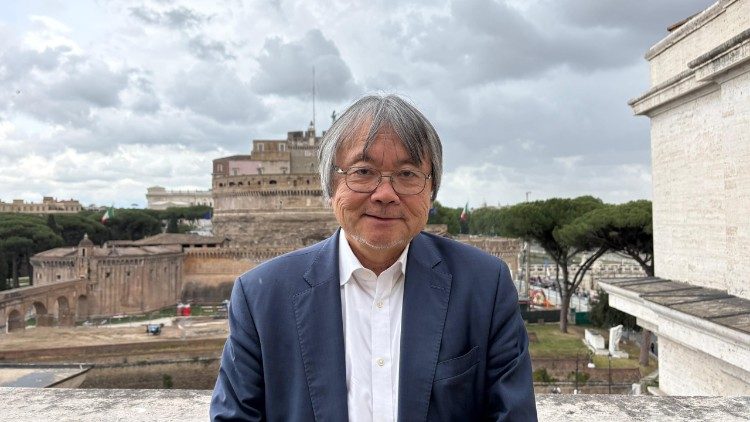
Our world is currently witnessing what the World Bank’s Vice President for Development Finance, Aki Nishio, describes as “two different worlds”.
On the one hand, there are many developing nations that continue to make significant progress. More children are attending school while more jobs are being created and access to healthcare is improving.
On the other hand, however, there is what Nishio tells us the World Bank’s Chief Economis has described as a “development-free zone” – countries in which progress has largely stalled.
In an interview with Vatican News, Nishio states that the dual impact of the Covid-19 pandemic and a significant drop in Official Development Assistance (ODA) has left some of the globe's most vulnerable countries struggling to move forward. "We have seen a lot of progress," he notes. "But, the progress is quite uneven."
Supporting the world's most fragile countries
The International Development Association (IDA), a key part of the World Bank, focuses much of its efforts on fragile and conflict-affected states. Around 40 per cent of IDA financing is directed towards countries facing the greatest instability and vulnerability.
In these regions, issues such as poverty, weak institutions, and conflict often overlap making development particularly difficult.
Yet Nishio stresses that supporting these countries is not only a humanitarian responsibility, but a global necessity. "If we have another pandemic emerging in one of these countries, the whole world will be affected."
He explains that weak healthcare systems can allow diseases to spread undetected, crossing borders and becoming global threats. Strengthening health services, infrastructure and basic public services is therefore essential not only for local communities, but for international stability as well.
Nishio then goes on to argue that while economic indicators remain important, the true measure of development is found in people's everyday lives. Speaking shortly after a visit to Kenya, he uses the country as an example, describing its remarkable progress since becoming an IDA recipient in the 1960s.
Since then, in fact, life expectancy has nearly doubled, while access to healthcare has expanded dramatically. "When you see these quantum changes", he says, "you can really see how people's lives have improved".
The transformation, however, he explains is not attributable to one sector alone.
Healthcare improvements rely on education, infrastructure and reliable public services. Hospitals need electricity to preserve vaccines. Roads are needed to transport patients and medical supplies. Communities require education to understand and access healthcare effectively.
Development, Nishio suggests, is ultimately about how these different elements come together to create opportunities for people to thrive.
Climate change: A burden carried by the poorest
Speaking of the consequences of climate change - ever more apparent - Nishio emphasises the difficult reality that the countries least responsible for climate change are often those suffering its harshest consequences. In Somalia, repeated droughts and floods have displaced hundreds of thousands of people, forcing families to abandon land they have cultivated for generations. "Developing countries have contributed very little to climate change," Nishio notes, "but they are taking the brunt of the negative effects." Coastal erosion, rising sea levels and increasingly unpredictable weather patterns are creating new forms of vulnerability, particularly in communities already struggling with poverty.
Through IDA, the World Bank supports climate adaptation projects, helping countries build resilient infrastructure and prepare for increasingly frequent climate shocks. "The need for such support is only going to grow," he warns.
Debt, solidarity and a moral responsibility
The question of debt has become increasingly prominent in recent years, particularly as Pope Francis repeatedly called for debt relief for struggling nations and urged wealthier countries to act in solidarity with poorer ones. Pope Leo XIV has likewise continued to draw attention to inequalities between the Global North and the Global South. Nishio acknowledges that debt distress is a growing concern across much of the developing world, however, he distinguishes between the highly concessional financing provided through IDA and the market-based loans that often place heavier burdens on developing economies. "The debt that is really tormenting these countries is largely non-concessional money," he explains.
IDA, by contrast, provides grants and low-interest financing designed specifically to support countries with limited repayment capacity. In 2025 alone, IDA delivered approximately 21 billion dollars in net flows to recipient countries, providing crucial liquidity and helping governments continue to deliver essential services.
From recipients to donors
Perhaps the strongest testament to the effectiveness of development assistance, Nishio argues, is the number of countries that have successfully moved beyond needing it. Since its creation, 33 countries have graduated from IDA support. Remarkably, 25 of them have since returned as donors.
South Korea stands among the most striking examples. Once one of the poorest countries in the world and an IDA recipient itself, it is now one of the largest contributors to the fund. "We did not ask them to come back," Nishio says. "They came on their own volition because IDA worked for them."
Countries across Asia and Eastern Europe have followed similar trajectories, transforming their economies and later choosing to support others facing challenges they once knew themselves.
For Nishio, these stories point to an often-overlooked truth about development assistance: when it succeeds, it creates the conditions for self-sufficiency rather than dependency.
At a moment when international cooperation is under pressure and aid budgets are shrinking, he sees this model as more important than ever. The challenge, he suggests, is not whether solidarity works, but whether the world is willing to continue investing in it.
Thank you for reading our article. You can keep up-to-date by subscribing to our daily newsletter. Just click here.