Jonathan Safran Foer: Literature awakens empathy that can change the world
By Francesca Merlo
“You think your pain and your heartbreak are unprecedented in the history of the world, but then you read. It was Dostoevsky and Dickens that taught me that the things that tormented me most were the very things that connected me with all the people who were alive, who had ever been alive.” - James Baldwin for LIFE Magazine, May 1963.
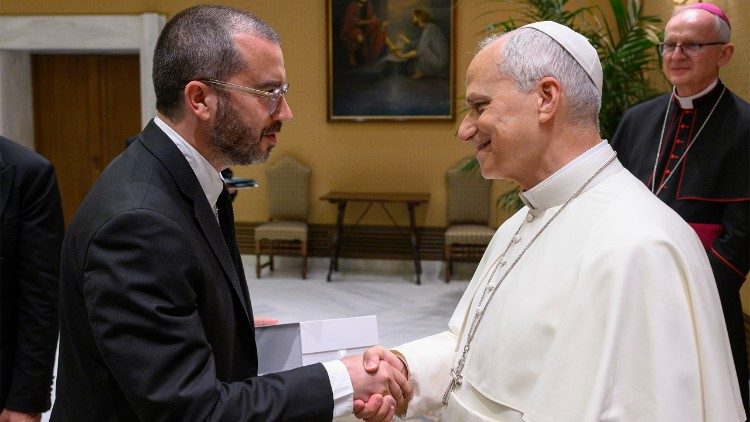
Jonathan Safran Foer stood beneath Bernini's Baldachin in St Peter's Basilica, moments after meeting Pope Leo XIV, reflecting on the quiet intimacy that exists between a writer and a reader.
“What literature does, and James Baldwin has written about this really beautifully, is it reminds us that the things we feel most deeply don't alienate us from other people. They connect us to other people,” he tells Vatican News.
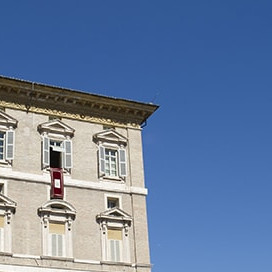
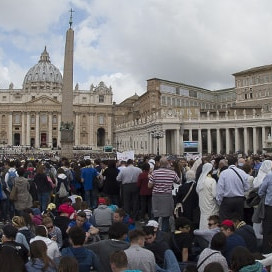
The American novelist and essayist had just joined dozens of authors from around the world on the 24th of June to celebrate the centenary of the Vatican Publishing House. Gathered in the Vatican, they listened to Pope Leo's reflections on the vocation of writers.
In his address, he described writing as an act of truth and humanity, encouraging writers to create spaces where empathy, dialogue and hope can flourish. He reminded writers that “truth is not a territory to be defended, but a good to be shared.” (Magnifica Humanitas, 25).
Art connects us to what we feel most deeply
“When I wrote my first book”, Foer recalls – the story of a young Jewish American writer who travels to Ukraine to find the woman who saved his grandfather from the Nazis - “I thought: who could possibly like this?” imagining that it would be a young Jewish man with similar experiences to the author and protagonist.
But a large number of those people did not. And as it turned out, many of the readers who connected most deeply with the novel had little in common with him at all.
“Some of the strongest responses I got were from people halfway around the world who were reading the book in translation, who did not share a religion with me, did not share my generation, did not share a language with me. It would seem that we had very few ways to communicate directly”, he continues.
“But then art reminds us that the things we feel most deeply don't care about all of those differences”.
Our relationship with truth
It is perhaps the ability to cross every cultural, linguistic and political boundary that gives literature its unique relationship with truth. Foer recognises this responsibility borne by those who write.
Public debate today often seems to revolve around defending truths, although Foer suggests that today's challenge is no longer simply a matter of disagreement.
Speaking of his home country of the United States, he says “we've gotten to a place that's even worse. Which is not competing truths, but an unwillingness to accept that there is such a thing as truth. There is no shared reality”.
He recognises the beauty of each person having a belief, and their own reasons for believing it, but warns that we have now reached a point of “we believe things without having reasons for them and without having evidence. They’re just our feelings, our gut”.
This, he notes, has been going on for more or less as long as social media has. And our leaders, he says, are not guilty of creating this reality. But they are guilty of giving it license, bringing it into the public and making it accepted. In his opinion, US political leaders have “weaponised the idea that there is no truth worth trusting”.
Speaking about what matters most
And for Foer, this issue extends beyond politics. It is reflected in humanity's response to one of the crises to which Foer has dedicated much of his writing.
“There is a reason you and I are standing here sweating profusely,” he tells me. “It’s unseasonably hot. And it’s unseasonably hot everywhere”.
The oppressive heat is an uncomfortable reminder that humanity already knows what is happening, and to Foer “it’s not a mystery why. We know conclusively why. We know that our choices as individuals, as communities, as countries are creating climate change”.
However, there is a clear gap between what happens when we know the truth and how we react. We have learned that knowledge alone is not enough to change behaviour and bring about action. “Humans have an amazing capacity to know something without really feeling it in their hearts in a way that might inspire action”.
What is needed, he suggests, is not simply more information, but the kind of moral imagination that enables people to feel the suffering of others as their own, because although we have recognised the problem “I don't think the solutions to our biggest problems will arise naturally,” Foer says. “They will arise because we find ways of reminding ourselves that we need to act”.
And that, he suggests, is one of the defining tasks of leadership. “There are no good leaders right now who are talking about, in conversational and inspiring ways, so many of our biggest problems”, he says. And, reflecting back to the setting which brought him here, that, he said, “is something that really distinguishes Pope Leo.”
Can literature inspire action?
The Pope's recent encyclical on artificial intelligence, Magnifica Humanitas, Foer went on to say, was “brilliant and important, but also frighteningly unique (…) speaking about it in ways that other leaders are not and have to be”.
Foer sees artificial intelligence as another example of a challenge that cannot be solved by awareness alone. “If the only response to AI is going to be individuals taking action, it's not going to be a self-correcting problem”, he said.
“It will be solved, if it is solved, because that knowing becomes action, and that will happen because we're inspired”. Whether literature can itself inspire that action, however, is a question which somewhat conflicts Foer.
“I don't know if it can”, he admits. “One of the things about writing is you really write into the dark”. Rather than setting out to persuade readers about climate change or politics, he says he simply writes about what matters most deeply to him.
It is there, unexpectedly, that literature reveals its power.
Art that opens people
Returning to the words of James Baldwin, Foer describes literature as something that reaches beneath language, nationality or belief.
“Hopefully literature, which has the ability to touch people in that primitive place that comes before your race, your religion, your language, your nationality - that's probably the place that needs to be touched in order to be awakened to suffering in the world”.
For him, this is not an argument for novels about climate change or immigration. “It's an argument for writing in a way that makes people feel empathy”. Because empathy, he believes, rarely remains confined to a single cause.
“People who feel empathy, who are open to the world, tend to feel very broad empathy”, he says. “My sense is there are people who are open and there are people who are closed... And art is a great tool for opening people”.
“I often wonder what I'd do if there weren't any books in the world.” - James Baldwin, Giovanni’s Room
Thank you for reading our article. You can keep up-to-date by subscribing to our daily newsletter. Just click here.